DEF 14A: Definitive proxy statements
Published on April 29, 2026
UNITED STATES
SECURITIES AND EXCHANGE COMMISSION
Washington, D.C. 20549
_________________
SCHEDULE 14A INFORMATION
Proxy Statement Pursuant to Section 14(a) of the
Securities Exchange Act of 1934
(Amendment No. )
_________________
Filed by the Registrant x | Filed by a party other than the Registrant o | ||||
Check the appropriate box:
| o | Preliminary Proxy Statement | ||||
| o | Confidential, for Use of the Commission Only (as permitted by Rule 14a-6(e)(2)) | ||||
| x | Definitive Proxy Statement | ||||
| o | Definitive Additional Materials | ||||
| o | Soliciting Material under § 240.14a-12 | ||||

(Name of Registrant as Specified in Its Charter)
(Name of Person(s) Filing Proxy Statement, if other than the Registrant)
Payment of Filing Fee (Check all boxes that apply):
| x | No fee required. | ||||
| o | Fee paid previously with preliminary materials. | ||||
| o | Fee computed on table in exhibit required by Item 25(b) per Exchange Act Rules 14a-6(i)(1) and 0-11. | ||||
PJT Partners Inc. 280 Park Avenue, New York, New York 10017 |  | ||||
April 29, 2026
Dear Fellow Shareholders,
We cordially invite you to attend our 2026 Annual Meeting of Shareholders, to be held on June 18, 2026, at 10:00 a.m., Eastern Daylight Time. The Annual Meeting will be a virtual meeting of shareholders. You will be able to attend the Annual Meeting, vote your shares electronically, and submit your questions during the meeting via live audio webcast by visiting http://www.virtualshareholdermeeting.com/PJT2026. To participate in the meeting, you must have your 16-Digit Control Number that is shown on your Notice of Internet Availability of Proxy Materials or on your proxy card if you elected to receive proxy materials by mail. You will not be able to attend the Annual Meeting in person.
The Notice of Annual Meeting of Shareholders and Proxy Statement that follow describe the business to be conducted at the Annual Meeting. Your vote is important. We encourage you to vote by proxy in advance of the Annual Meeting, whether or not you plan to participate.
Thank you for your continuing support of PJT Partners.
Very truly yours,
Paul J. Taubman
Chairman and Chief Executive Officer
| |||||
PJT Partners Inc.
280 Park Avenue, New York, New York 10017
Notice of 2026 Annual Meeting of Shareholders
| Meeting Information | ||||||||||||||||||||||||||
Date: Thursday, June 18, 2026 | Time: 10:00 a.m. Eastern Daylight Time | Record Date: April 20, 2026 | ||||||||||||||||||||||||
Place: Virtual format only. If you plan to participate in the virtual meeting, please see “Participation in Our Annual Meeting” below. Shareholders will be able to participate, vote, examine the shareholders list, and submit questions (both before, and for a portion of, the meeting) from any location via the Internet. Shareholders may participate by logging in at: www.virtualshareholdermeeting.com/PJT2026. To participate, you must have your 16-Digit Control Number that is shown on your Notice of Internet Availability of Proxy Materials or on your proxy card if you elected to receive proxy materials by mail. | ||||||||||||||||||||||||||
| Items of Business | ||
Proposal 1. Election to our Board of Directors of three Class II director nominees identified in this Proxy Statement | ||
Proposal 2. Approval, on an advisory basis, of the compensation of our Named Executive Officers as disclosed in this Proxy Statement | ||
Proposal 3. Ratification of the selection of Deloitte & Touche LLP as our independent registered public accounting firm for 2026 | ||
To transact such other business as may properly come before our Annual Meeting or any adjournments or postponements thereof. | ||
Your vote is important to us. Please exercise your shareholder right to vote.
By Order of the Board of Directors,

David K.F. Gillis
Corporate Secretary
April 29, 2026
Important notice regarding the availability of our Proxy Statement, 2025 Annual Report to Shareholders, and other materials relating to our 2026 Annual Meeting of Shareholders (our "Proxy Materials"). Our Proxy Materials are available at http://www.virtualshareholdermeeting.com/PJT2026. Our Proxy Materials will be mailed or made available to our shareholders on or about April 29, 2026. We are sending to most of our shareholders a Notice of Internet Availability of Proxy Materials (the “Notice of Availability”) rather than a paper set of our Proxy Materials. By doing so, we save costs and reduce our impact on the environment. The Notice of Availability includes instructions on how to access our Proxy Materials over the Internet, as well as how to request our Proxy materials in paper form. On or about April 29, 2026, we will mail to most of our shareholders the Notice of Availability.
| |||||
Table of Contents
| |||||
Appendix A - Glossary of Terms | |||||
Appendix B - U.S. GAAP Reconciliations | |||||
Although we refer to websites and other documents in this Proxy Statement, the contents of such websites and documents are not included or incorporated by reference into this Proxy Statement. All references to websites in the Proxy Statement are intended to be inactive textual references only.
| |||||
Executive Summary
This summary highlights information from PJT Partners Inc.’s Proxy Statement for the 2026 Annual Meeting of Shareholders.1 You should read this entire Proxy Statement carefully before voting. Please refer to the Glossary of Terms in Appendix A for definitions of some of the terms used in this Proxy Statement. Your vote is important. For more information on voting and participating in the Annual Meeting, see “Participation in Our Annual Meeting” below.
Our Company
PJT Partners2 is a premier, global, advisory-focused investment bank that was built from the ground up to be different. Our highly experienced, collaborative teams provide independent advice coupled with old-world, high-touch client service. This ethos has allowed us to attract some of the very best talent in the markets in which we operate. We deliver leading advice to many of the world's most consequential companies, effect some of the most transformative transactions and restructurings, and raise billions of dollars of capital around the globe to support startups and more established companies.
2025 Highlights3
| Financials | ||||||||
$1.71bn Total Revenues, an increase of 15% YoY | 20.0% GAAP Pretax Margin 20.8% Adjusted4 Pretax Margin | $6.68 GAAP Diluted EPS, an increase of 36% YoY $6.98 Adjusted4 EPS, an increase of 39% YoY | ||||||
| Capital Management | ||||||||
2.4mm Shares and share equivalents repurchased | $586mm Cash, cash equivalents and short-term investments; No funded debt | $1.00 Annual dividend per share | ||||||
______________________________
1PJT Partners Inc. is a holding company, and its only material asset is its controlling equity interest in PJT Partners Holdings LP (“PJT Partners Holdings”), a holding partnership that holds our company’s operating subsidiaries, and certain cash and cash equivalents it may hold from time to time. As the sole general partner of PJT Partners Holdings, PJT Partners Inc. operates and controls all of the business and affairs and consolidates the financial results of PJT Partners Holdings and its operating subsidiaries. PJT Partners Inc.’s common stock trades on the New York Stock Exchange (“NYSE”) under the symbol “PJT.”
2In this Proxy Statement, unless the context requires otherwise, the words “PJT Partners” refer to PJT Partners Inc., and our “company,” “we,” “us,” and “our” refer to PJT Partners, together with its consolidated subsidiaries, including PJT Partners Holdings and its operating subsidiaries.
3As of December 31, 2025.
4Figures are shown ‘as adjusted,’ a non-GAAP financial measure. See Appendix B, “U.S. GAAP Reconciliations” for a reconciliation of non-GAAP financial measures with comparable GAAP financial measures.
 | 1 | |||||||
| Executive Summary | | ||||
| Footprint | ||||||||
133 Partners globally | 1,224 Company-wide headcount, an increase of 7% YoY | 16 Offices worldwide; Opened Riyadh and Stockholm offices in 2025 | ||||||
| Supporting Our Communities | ||
>550 Charitable organizations supported by PJT Partners | ||
| Board Governance | |||||||||||
Board Refreshment In 2025, our Board of Directors (our "Board") appointed Peter L.S. Currie as a director, increasing our Board's size to eight directors. Mr. Currie brings additional senior executive experience to our Board, having served in leadership roles in high-growth, technology-driven companies. | |||||||||||
Enhanced Focus on Emerging Risks Our Board has increased the time it dedicates to oversight and discussion of emerging risk topics identified by directors and management, including regular engagement with experts on geopolitical developments, artificial intelligence, and cybersecurity, and how these risks affect our stakeholders and our strategy. | |||||||||||
Director Independence Seven of our Board's eight directors (87.5%) are independent. | |||||||||||
Proposal 1: Election of Directors
Our Board has nominated three directors, K. Don Cornwell, Peter L.S. Currie, and Thomas M. Ryan, for election as Class II directors. If elected, each Class II director will serve until the annual meeting of shareholders in 2029, or until succeeded by another qualified director who has been elected.
Our Board recommends that you vote “FOR” each director nominee.
Nominees for Class II Directors Whose Terms Will Expire in 2029
| Director | Age | Independent | Director Since | ||||||||
| K. Don Cornwell | 55 | Yes | January 2023 | ||||||||
| Peter L.S. Currie | 69 | Yes | July 2025 | ||||||||
| Thomas M. Ryan | 73 | Yes | October 2015 | ||||||||
2 | | |||||||
| Executive Summary | | ||||
Proposal 2: Advisory Resolution to Approve Executive Compensation
Our Board recommends that you vote “FOR” the approval, on an advisory basis, of the compensation of our Named Executive Officers.
Key reasons to vote “FOR” the approval, on an advisory basis, of the compensation of our Named Executive Officers:
Our compensation program includes elements that are intended to ensure strong alignment between the interests of our Named Executive Officers and our shareholders:
>Annual incentive compensation that places a strong emphasis on company-wide financial performance, with consideration given to the individual performance of each Named Executive Officer
>An appropriate link between compensation and the creation of shareholder value through long-term equity awards
>A focus on collaboration, and therefore does not include individual revenue pay-outs at any level
>Consideration for each Named Executive Officer's contribution to leadership and talent development
>Benchmarking analysis using an independent compensation consultant to help us understand compensation practices of our competitors
Our compensation program for our Named Executive Officers and our company overall aims to be market- competitive versus our peers, in both quantum and structure, to ensure that we are able to attract and retain executives and other professionals that contribute to the long-term success of our company.
Proposal 3: Ratification of Our Company’s Independent Registered Public Accounting Firm
Our Audit Committee has appointed Deloitte & Touche LLP (“Deloitte”) as our company’s independent registered public accounting firm to audit the Consolidated Financial Statements of PJT Partners Inc. and its subsidiaries for the year ending December 31, 2026. A resolution is being presented to our shareholders requesting ratification of the appointment of Deloitte.
Our Board recommends that you vote “FOR” the ratification of the appointment of Deloitte as our company’s independent registered public accounting firm.
| 3 | |||||||
| Executive Summary | | ||||
No Super-Voting Shares
It is important to note that while we have two classes of stock—Class A common stock and Class B common stock1—neither class provides its holders with super-voting rights. Whereas some companies with a dual-class stock voting structure give certain shareholders super-voting stock, we do not. Holders of our Class A common stock have one vote for every share of Class A common stock that such holder owned at the close of business on the Record Date. Holders of our Class B common stock have one vote for every Partnership Unit that such holder owned at the close of business on the Record Date, except in connection with the election of directors where holders of our Class B common stock are limited to one vote per share of Class B common stock and thereby have less voting power in the election of directors than holders of Class A common stock. However, as permitted by our Restated Certificate of Incorporation, certain holders of our Class B common stock have requested the equalization of their voting rights with respect to their Class B common stock and, subject to approval by our Board, also may have one vote for every Partnership Unit that such holder owned at the close of business on the Record Date for the election of directors, placing such holders on equal footing with holders of Class A common stock. See “Shares to be Voted at the Annual Meeting; Our Voting Structure Does not Contain Super-Voting Powers” below.
1 Certain holders of the equity in our company maintain their ownership through partnership interests in PJT Partners Holdings. These ownership interests comprise variously designated partnership units, including partnership units designated as "LTIP Units" and "Performance LTIP Units" as described throughout this Proxy Statement (collectively, "Partnership Units" refers to equity interests in our company held by owners who maintain their ownership collectively through PJT Partners Holdings partnership units, including LTIP Units and Performance LTIP Units). To ensure that Partnership Unit holders are entitled to vote their economic interests in our company, these holders were granted an accompanying share of Class B common stock.
4 | | |||||||
| |||||
Corporate Governance
| Proposal 1: Election of Directors | ||||||||
| Our Board has nominated three directors, K. Don Cornwell, Peter L.S. Currie, and Thomas M. Ryan, for election as Class II directors. If elected, each Class II director will serve until the annual meeting of shareholders in 2029, or until succeeded by another qualified director who has been elected. | ||||||||
| Board Recommendation | ||||||||
| Our Board recommends that you vote “FOR” each director nominee. | ||||||||
This section of our Proxy Statement contains information about our Board of Directors, including our nominees, and key elements of our corporate governance. Our Board places great value on strong governance controls, and we have structured our corporate governance in a manner we believe closely aligns with the best interests of our company and our shareholders.
The nominees have consented to being named in this Proxy Statement and to serve if elected. Our Board has no reason to believe that any nominee will be unavailable or unable to serve as a director, but if for any reason any nominee should not be available or able to serve, the shares represented by all valid proxies will be voted by the person or persons acting under said proxy in accordance with the recommendation of our Board.
Meet Our Board of Directors
Our Board consists of eight directors, all of whom are independent with the exception of Paul J. Taubman (our Chairman and CEO). Our Board is classified into three classes, designated as Class I, Class II, and Class III. The term of office of the members of one class of directors expires each year in rotation so that the members of one class generally are elected at each annual meeting to serve for full three-year terms or until their successors are elected, or until such director’s death, resignation, or retirement. Each class consists, as nearly as possible, of one-third of the total number of directors constituting the entire Board.
Our Board is comprised of actively engaged individuals with a variety of skills, experiences, and backgrounds that contribute to the effective oversight of our company. Our Board believes these varied qualifications help to inform and oversee decisions regarding our company’s long-term strategic growth. Under the guidance of our Nominating/Corporate Governance Committee, our Board reviews the structure of our Board, its committees, and the individual directors and, as part of that process, considers, among other things, issues of structure, leadership, oversight, and skills to guide our company in executing its long-term strategic objectives.
| 5 | |||||||
| Corporate Governance | | ||||
Experience and Skills of Our Directors and Nominees
Each of our directors and nominees is a highly accomplished and experienced professional with fundamental attributes of senior leadership including integrity, honesty, intellectual curiosity, good judgment, strong work ethic, strategic thinking, vision, commitment to mission, excellent communication and collaboration skills, and the ability and willingness to challenge management constructively when needed. In addition to these and other core attributes, each of our directors and nominees possesses a variety of other skills and experience necessary to carry out our Board’s responsibilities. The presentation below is a high-level summary of those skills and experience found on our Board, with information provided by the directors and nominees:
Board Characteristics
Our Board is composed of highly accomplished, actively engaged individuals with broad-based skills and experiences and varied backgrounds who share our commitment to excellence, collaboration, and integrity. Our Board believes that fostering a highly collaborative culture both at our Board level and throughout our company enables us to provide the best advice and insights to our clients and better serve our stakeholders. Since our founding, our Board has been, and continues to be, deliberate in seeking and electing new directors who enhance its composition and collective skills. Consistent with our commitment to continuous improvement, our Board annually assesses its collective mix of skills, experience, and backgrounds, to ensure that these characteristics continue to align with our evolving business strategy and with our Board’s role in overseeing our company’s achievement of its long-term objectives. We also note that (i) seven of our eight Board members are independent, (ii) our directors have an average tenure of 8 years and an average age of 68 years, and (iii) of our eight Board members, two of our directors are women and one of our directors is Black/African American.
| Banking & Financial Services | Breadth and depth of experience in our company’s business and industry | ||||||||||
| Executive Experience | Experience in senior management roles, including serving as a CEO or senior executive, within a complex organization | ||||||||||
| Financial Reporting | Expertise in overseeing the presentation of financial results as well as internal controls | ||||||||||
| Human Capital Management | Experience in talent management and employee compensation | ||||||||||
| International Business | Broad leadership experience within global companies and understanding of international markets | ||||||||||
| IT & Cybersecurity | Expertise or experience in information technology, including understanding the importance of maintaining the trust of our clients through the protection of their information | ||||||||||
| Legal & Regulatory | Experience in legal and regulatory affairs and regulated industries, including as part of a business and/or through positions with government and/or regulatory bodies | ||||||||||
| Marketing & Media | Experience overseeing internal and external communications and engagement with stakeholders | ||||||||||
6 | | |||||||
| Corporate Governance | | ||||
| Public Company Experience | Previous or current service as a director of other publicly traded companies | ||||||||||
| Risk Management | Experience overseeing complex risk management matters | ||||||||||
| Strategic Planning | Experience driving the strategic direction and growth of an organization | ||||||||||
| Corporate Sustainability | Expertise or experience in corporate sustainability matters | ||||||||||
| Professional Skills | Cornwell | Costos | Currie | Rafferty | Ryan | Skaugen | Taubman | Whitney | |||||||||||||||||||||
| Banking & Financial Services | ü | ü | ü | ü | ü | ü | ü | ü | |||||||||||||||||||||
| Executive Experience | ü | ü | ü | ü | ü | ü | ü | ||||||||||||||||||||||
| Financial Reporting | ü | ü | ü | ü | ü | ü | ü | ||||||||||||||||||||||
| Human Capital Management | ü | ü | ü | ü | ü | ü | ü | ü | |||||||||||||||||||||
| International Business | ü | ü | ü | ü | ü | ü | ü | ||||||||||||||||||||||
| IT & Cybersecurity | ü | ü | ü | ü | ü | ||||||||||||||||||||||||
| Legal & Regulatory | ü | ü | ü | ü | ü | ||||||||||||||||||||||||
| Marketing & Media | ü | ü | ü | ü | ü | ü | |||||||||||||||||||||||
| Public Company Experience | ü | ü | ü | ü | ü | ü | |||||||||||||||||||||||
| Risk Management | ü | ü | ü | ü | ü | ü | ü | ||||||||||||||||||||||
| Strategic Planning | ü | ü | ü | ü | ü | ü | ü | ü | |||||||||||||||||||||
| Corporate Sustainability | ü | ü | ü | ü | ü | ||||||||||||||||||||||||
| 7 | |||||||
| Corporate Governance | | ||||
Nominees for Class II Directors Whose Terms Will Expire in 2029
 | Professional Highlights K. Don Cornwell is a Co-Founder and the Chief Executive Officer of Dynasty Equity, a global sports investment firm focused on strategic investments across the sports ecosystem. Prior to founding Dynasty Equity in 2023, Mr. Cornwell was a founding partner at PJT Partners, joining our company in 2015 following an 18-year career at Morgan Stanley. At Morgan Stanley, Mr. Cornwell was in the Mergers and Acquisitions Group and established a particularly focused area of expertise in media and entertainment, specifically in sports and gaming. Prior to leaving Morgan Stanley, he served as Head of Global Sports Investment Banking. Before he joined Morgan Stanley, Mr. Cornwell worked at McKinsey & Co. as a management consultant and in corporate development for the National Football League. He sits on the Board of Trustees of the Harlem Children’s Zone, an education and social services organization in Central Harlem; the East Harlem Tutorial Program, an after-school program for children in East Harlem; Mission 44 (U.S. Board), a global charitable foundation founded by Sir Lewis Hamilton focused on promoting access to education and careers in STEM; the Board of Directors of New York Cares, New York City’s largest volunteer organization, and the VFILES Foundation, an organization with the mission to increase business ownership for creators in underrepresented communities. Mr. Cornwell served on the Management Board of Stanford University’s Graduate School of Business until July 2022. He received an MBA from Stanford University’s Graduate School of Business and an AB in Government from Harvard College. Skills & Qualifications Mr. Cornwell’s extensive experience and expertise in investment banking and in the financial services industry, as well as his deep knowledge of PJT Partners’ business, operations and culture, and his understanding of our company’s clients, employees and other stakeholders, position him to contribute valuable acumen and insight to our Board. | |||||||||||||
| K. Don Cornwell | ||||||||||||||
Age: 55 | ||||||||||||||
Director since: January 2023 | ||||||||||||||
8 | | |||||||
| Corporate Governance | | ||||
 | Professional Highlights Peter L.S. Currie is the President of Currie Capital LLC, a private investment firm, and previously served as Executive Vice President and Chief Administrative Officer of Netscape Communications Corporation and as Executive Vice President and Chief Financial Officer of McCaw Cellular Communications, Inc. Prior to these roles, Mr. Currie spent nine years in investment banking at Morgan Stanley. In addition to his management experience, Mr. Currie has served on the boards of directors and audit committees of Twitter, Inc., Schlumberger Limited, New Relic, Inc., Clearwire Corporation, CNET Networks, Inc., Safeco Corporation, and Sun Microsystems, Inc. Mr. Currie previously served as President of the Board of Trustees of Phillips Academy. Mr. Currie holds a B.A. in Economics and French Literature from Williams College and an M.B.A. from Stanford University. Skills & Qualifications Mr. Currie’s extensive expertise and experience in senior leadership roles at high-growth, technology-driven companies enable him to contribute strategic judgment and perspective to our Board. | |||||||||||||
| Peter L.S. Currie | ||||||||||||||
| Audit Committee Chair | ||||||||||||||
Age: 69 | ||||||||||||||
Director since: July 2025 | ||||||||||||||
 | Professional Highlights Thomas M. Ryan is the former Chairman and Chief Executive Officer of CVS Health Corporation, formerly known as CVS Caremark Corporation, a pharmacy healthcare provider (“CVS”). He served as Chairman of CVS from April 1999 to May 2011 and Chief Executive Officer of CVS from May 1998 to February 2011, and also served as President from May 1998 to May 2010. Mr. Ryan serves on the Board of Five Below, Inc. and is an Operating Partner of Advent International. Mr. Ryan was a director of Yum! Brands, Inc. from 2002 to 2017, Reebok International Ltd. from 1998 to 2005, Bank of America Corporation from 2004 to 2010 and Vantiv, Inc. from 2012 to 2015. Skills & Qualifications Mr. Ryan’s role as Chairman and Chief Executive Officer of a global pharmacy healthcare business, his extensive operations and management experience, his expertise in finance and strategic planning, as well as his public company directorship and committee experience, position him well to serve on our Board. | |||||||||||||
| Thomas M. Ryan | ||||||||||||||
| Lead Independent Director and Compensation Committee Chair | ||||||||||||||
Age: 73 | ||||||||||||||
Director since: October 2015 | ||||||||||||||
| 9 | |||||||
| Corporate Governance | | ||||
Continuing Class I Directors Whose Terms Will Expire in 2028
 | Professional Highlights Paul J. Taubman is the Founder, Chairman, and Chief Executive Officer of PJT Partners. Since its founding, PJT Partners has become one of the most respected advisory firms in the industry. Prior to founding PJT Partners in 2015, Mr. Taubman spent nearly 30 years at Morgan Stanley, where he served in a series of increasingly senior leadership positions, including Executive Vice President and Co-President of Institutional Securities, with responsibility for all of that firm’s investment banking, capital markets and sales and trading businesses. Mr. Taubman is actively involved in philanthropic efforts, serving as Board President of New York Cares, New York City’s largest volunteer organization; Vice Chairman of Cold Spring Harbor Laboratory; Board Member of the Partnership for New York City; Advisory Council member at the Stanford Graduate School of Business; National Advisory Board member of Youth, Inc.; and Trustee of the Foundation for Empowering Citizens with Autism. Mr. Taubman received a BS in Economics from the Wharton School of the University of Pennsylvania and an MBA from Stanford University’s Graduate School of Business. Skills & Qualifications Mr. Taubman’s extensive experience gained from various senior leadership roles in investment banking and the financial services industry, as well as his many years of providing strategic advice to management teams and boards around the world operating in a wide array of industries, bring valuable knowledge and expertise to our Board. In addition, Mr. Taubman’s role as our Chief Executive Officer brings management perspective to Board deliberations and provides critical information about the status of our day-to-day operations. | |||||||||||||
| Paul J. Taubman | ||||||||||||||
| Chairman and Chief Executive Officer | ||||||||||||||
Age: 65 | ||||||||||||||
Director since: October 2015 | ||||||||||||||
10 | | |||||||
| Corporate Governance | | ||||
 | Professional Highlights Emily K. Rafferty is President Emerita of The Metropolitan Museum of Art. Beginning in 1976 and working in various roles in development, membership, and external affairs, she was elected President of the Museum in 2005 and served in that capacity until her retirement in March 2015. During her time as President and Chief Administrative Officer, Ms. Rafferty oversaw more than 2,000 full- and part-time employees and volunteers. Her work spanned a global reach during international negotiations for fundraising, diplomatic, and travel initiatives, including collaborations with the United Nations, the U.S. State Department, and many world leaders. Ms. Rafferty currently serves as a Vice Chair of the National September 11 Memorial & Museum, a Board Trustee of Carnegie Hall, and a member of the Board of Advisors for Hospital for Special Surgery, the Global Asia Society, and the Hispanic Society Museum and Library. She is a member of the Advisory Council of the American University of Beirut as well as the Council on Foreign Relations. Ms. Rafferty served as a board member of the New York Federal Reserve Bank from 2011 to 2017 (Chair, 2012 to 2016) and Koç Holdings, Istanbul from 2018 to 2024, Senior Advisor for Heritage Protection and Conservation for UNESCO from 2015 to 2017, and was Chair of NYC & Company (the city’s tourism, marketing and partnering organization) from 2008 to 2020, where she continues to serve as an ex-officio board member. She previously consulted for Russell Reynolds Associates in that firm’s non-profit sector and for The Shed, a NYC performing arts center. Ms. Rafferty is principal of Emily K. Rafferty & Associates, a consulting resource for non-profit institutions. Skills & Qualifications Ms. Rafferty’s decades of experience in human capital management, operations, and senior executive leadership, as well as her global expertise and understanding of monetary policy and regulation of financial institutions provide invaluable knowledge and insight to our Board. | |||||||||||||
| Emily K. Rafferty | ||||||||||||||
| Nominating/Corporate Governance Committee Chair | ||||||||||||||
Age: 77 | ||||||||||||||
Director since: October 2015 | ||||||||||||||
| 11 | |||||||
| Corporate Governance | | ||||
Continuing Class III Directors Whose Terms Will Expire in 2027
 | Professional Highlights James Costos served as the United States Ambassador to the Kingdom of Spain and the Principality of Andorra from August 2013 to January 2017. Before his diplomatic appointment, he built a distinguished career in the entertainment and international business sectors, including his tenure as Vice President at Home Box Office (HBO) from 2007 to 2013, as well as his leadership roles at Revolution Studios, Tod's S.p.A, and Hermès of Paris. Mr. Costos currently serves as President at Secuoya Studios, a leading global Spanish television and film production company headquartered in Madrid. He has served on the J. William Fulbright Foreign Scholarship Board and on the board of Grifols, S.A. Deeply committed to cultural and humanitarian advancement, he also sits on the boards of the Hispanic Society of America and the Human Rights Campaign. Mr. Costos holds a Bachelor of Arts degree in Political Science from the University of Massachusetts. Skills & Qualifications Mr. Costos’ international government relations and policy experience and his international marketing, operations, technology and executive leadership experience position him well to serve on our Board. His strong international experience brings a geographically diverse perspective to the oversight of our multi-national business operations. | |||||||||||||
| James Costos | ||||||||||||||
Age: 63 | ||||||||||||||
Director since: February 2017 | ||||||||||||||
12 | | |||||||
| Corporate Governance | | ||||
 | Professional Highlights Grace Reksten Skaugen, a Norwegian national, has extensive experience working with a broad array of European companies. She currently chairs Orrön Energy AB (Chair of the Compensation Committee) and is a board member of Investor AB (Chair of the Audit and Risk Committee). Ms. Skaugen is also a trustee and Honorary Treasurer of the International Institute for Strategic Studies (IISS) in London. In 2009, Ms. Skaugen co-founded the Norwegian Institute of Directors, where she still serves on its board as Deputy Chair. She previously served as a senior advisor to HSBC (2014-2019) and Deutsche Bank (2007-2014). She was deputy chair (2012-2015) of the Norwegian oil company Statoil (now Equinor) and served on its board (2002-2015). Ms. Skaugen served as deputy chair (2013-2020), board member (2012-2020) and chair of the Compensation Committee at Orkla ASA, was a board member and member of the Compensation and Sustainability Committees at Lundin Energy AB (2015-2022) and chaired Euronav NV (where she was a member of the Compensation Committee, Sustainability Committee and Corporate Governance and Nomination Committee) (2016-2023). She has previous investment banking experience, having worked at the Nordic bank SEB, where she advised companies within the energy, transportation and technology sectors. Ms. Skaugen started her career as a postdoctoral researcher at Columbia Radiation Laboratory in New York. She is a physicist by education and holds a PhD in laser physics from Imperial College in London. She also holds an M.B.A. from the Norwegian School of Management, BI. Skills & Qualifications Ms. Skaugen’s experience and expertise in the international financial services industry, as well as her extensive corporate governance and board experience, provide unique insights into our business and add industry-specific expertise and knowledge to our Board. Her strong international experience brings a geographically diverse perspective to the oversight of our multi-national business operations. | |||||||||||||
| Grace R. Skaugen | ||||||||||||||
Age: 72 | ||||||||||||||
Director since: July 2020 | ||||||||||||||
| 13 | |||||||
| Corporate Governance | | ||||
 | Professional Highlights Kenneth C. Whitney has managed a private family investment office since April 2013, focused on start-up businesses and entertainment projects. Mr. Whitney was previously a Senior Managing Director and Head of Blackstone’s Investor Relations & Business Development Group from 1998 to April 2013. After joining Blackstone in 1988, Mr. Whitney focused his efforts on raising capital for Blackstone’s private investment funds and the establishment of Blackstone affiliates in the alternative investment area. Since his retirement from Blackstone in April 2013 until September 2015, he was also a Senior Advisor to Blackstone. Mr. Whitney began his career at Coopers & Lybrand in 1980, where he spent time in that firm’s accounting and audit areas as well as in the tax and mergers and acquisitions areas. Mr. Whitney is a BAFTA- and Tony Award-winning producer, currently sits on the Board of Governors of The First Tee, and is the Chair of the Investment Committee for the Endowment of the University of Delaware, where he received a B.S. in Accounting. Skills & Qualifications Mr. Whitney’s experience and expertise in the private equity and financial services industry, as well as his extensive financial, accounting, operations and management experience, provide unique insights into our business and add industry-specific expertise and knowledge to our Board. | |||||||||||||
| Kenneth C. Whitney | ||||||||||||||
Age: 68 | ||||||||||||||
Director since: October 2015 | ||||||||||||||
14 | | |||||||
| Corporate Governance | | ||||
Our Board's Guiding Principles and Governance Practices
As our business continues to grow and evolve over time, we are committed to ensuring that our governance practices reflect our Board’s perspective on what is in the best interest of our shareholders and our company to protect and promote long-term value, while taking into consideration the feedback we receive from our stakeholders. Our Board also reviews the practices of our broader industry to inform its perspectives on these matters. The following table summarizes certain highlights of our Board’s guiding principles as well as corporate governance practices and policies that support strong oversight of our company’s strategy and key risks:
| Breadth of Skills and Expertise | Since our founding, we have sought to ensure that each director brings to our Board a level of experience and skill that would be expected on the board of a much larger public company, to achieve our company’s long-term strategic goals while providing strong oversight of our risk profile and progress in achieving these goals. Our Board is committed to the ongoing evaluation of our directors’ contributions, including the skills and expertise of each director and how their collective skills align with our evolving business strategy. | |||||||||||||
| Commitment to Inclusive Culture | Our Board believes that fostering an inclusive culture enables us to provide best-in-class advice to our clients. Accordingly, we aim to hire, develop, and retain best-in-class talent across all levels of our company, including our Board itself. | |||||||||||||
| Independent & Engaged Board | Seven of our eight directors are independent, with all Board committees comprised entirely of independent directors. Our Board is actively engaged, holding four Board meetings and 18 Board committee meetings in 2025, as well as taking action through unanimous written consent. Directors actively engage and spend time with our senior management and other employees in a variety of forums outside of the board room. | |||||||||||||
| Focused Directors | Because serving on our Board requires significant time and attention, our Board has adopted a policy within its Corporate Governance Guidelines that, among other requirements applicable to our Board, set the expectation that directors will spend the time needed and meet as often as necessary to discharge their responsibilities properly. The Corporate Governance Guidelines also set expectations for the maximum number of public company boards a director may serve on and the maximum number of public company audit committees an Audit Committee member may serve on and provide for a Board review process and public disclosure requirements relating to these expectations. See “Corporate Governance Guidelines” below. | |||||||||||||
| Strong Lead Independent Director | Our Board’s Lead Independent Director facilitates independent oversight of management. Our Lead Independent Director is responsible for coordinating the efforts of the non-management directors to ensure that objective judgment is brought to bear on important issues involving the management of our company, including the performance of senior management. See “Board Leadership Structure — Lead Independent Director” below. | |||||||||||||
| Shareholder Engagement | As part of our ongoing shareholder engagement program, we contact many of our largest shareholders to discuss a range of topics related to our company’s strategy, governance profile, executive compensation practices, corporate sustainability, human capital management, financial performance, and other matters. A thematic summary of recent investor conversations is included under the section “Shareholder Engagement” below. | |||||||||||||
| Annual Evaluations | Our Board conducts a self-evaluation annually to determine whether it, its committees, and its individual members are functioning effectively and whether our Board possesses the appropriate expertise and qualifications. Each committee of our Board also conducts a self-evaluation annually and reports the results to our Board. Our Board, acting through our Nominating/Corporate Governance Committee, monitors the mix of specific experience, qualifications, skills, and backgrounds of its current directors in order to assure that our Board, as a whole, has the necessary tools to perform its oversight function effectively in light of our company’s business and structure. | |||||||||||||
| Open Channels of Communication Between our Board and our Company | Our Board maintains open channels of communication across our company. Our directors engage and spend time with our partners and employees throughout the year in a variety of forums. Our directors periodically attend partner meetings and dinners, participate in our town hall meetings, and meet with groups and individuals at our company. | |||||||||||||
| Minimum Equity Ownership Guidelines | We have minimum equity ownership guidelines for our directors that require significant ownership of our common stock. Our directors are required to hold equity in our company with a market value equal to or greater than three times their annual retainer. All of our directors are, or are expected to be within the time ascribed in our ownership guidelines, in compliance with our Minimum Equity Ownership Guidelines. | |||||||||||||
| 15 | |||||||
| Corporate Governance | | ||||
Board Leadership Structure
Chairman of Our Board
Our Board understands there is no single, generally accepted approach to providing board leadership and that given the dynamic and competitive environment in which we operate, the appropriate leadership may vary as circumstances warrant. Our Restated Certificate of Incorporation provides that Mr. Taubman, to the extent that he serves as our CEO and as a member of our Board, will serve as Chairman of our Board. Further, our Board currently believes it is in our company’s best interests to have Mr. Taubman serve as Chairman of our Board as well as our CEO. Our Board believes combining these roles promotes effective leadership and provides the clear focus needed to execute our business strategy and objectives.
Lead Independent Director
Another important part of our Board’s leadership structure is the robust role of the Lead Independent Director. Our Board has appointed Mr. Ryan as its Lead Independent Director and, in this role, Mr. Ryan helps coordinate the efforts of the non-management directors to ensure that objective judgment is brought to bear on important issues involving the management of our company, including the performance of senior management. The authority and responsibility of our Lead Independent Director role is summarized in the following presentation:
Strong Lead Independent Director
The Lead Independent Director:
| Presides over all meetings of our Board at which the Chairman is not present, including any executive sessions of the independent directors or the non-management directors | ||||||||
| Provides leadership and serves as temporary Chairman in the event of the inability of the Chairman to fulfill his role due to crisis or other event or circumstance that would make leadership by existing management inappropriate or ineffective, in which case the Lead Independent Director shall have the authority to convene meetings of the full Board or management | ||||||||
| Assists in scheduling Board meetings and approves meeting schedules to ensure that there is sufficient time for discussion of all agenda items | ||||||||
| Collaborates with the CEO in determining the need for special meetings of our Board | ||||||||
| Collaborates with the CEO on Board meeting agendas and approves such agendas | ||||||||
| Communicates to the CEO, together with the Chairman of our Compensation Committee (if the Lead Independent Director and the Chairman of our Compensation Committee are not the same person), the results of our Board’s evaluation of CEO performance | ||||||||
| Coordinates and leads Chairman and CEO succession planning, including in executive sessions | ||||||||
Confers with the Chairman and CEO and senior management on the overall strategy of our company | ||||||||
| Is available for consultation and direct communication if requested by major shareholders | ||||||||
| Acts as the liaison between the independent or non-management directors and the Chairman, as appropriate | ||||||||
| Calls meetings of the independent or non-management directors when necessary and appropriate | ||||||||
| Provides leadership, in conjunction with the Chairman, in our Board evaluation process | ||||||||
16 | | |||||||
| Corporate Governance | | ||||
Board Committees
Our Board has three standing committees: an Audit Committee, a Compensation Committee, and a Nominating/Corporate Governance Committee. The current charters for these committees are available on our corporate website, at www.pjtpartners.com, under the “Investors/Corporate Governance/Governance Documents” section. Further, we will provide copies of these charters without charge to any shareholder upon written request. Requests for copies should be addressed to our Corporate Secretary. Our Board also may create additional committees for such purposes as our Board may determine.
Board Committee Membership at a Glance
| Audit Committee | Compensation Committee | Nominating/Corporate Governance Committee | |||||||||
| K. Don Cornwell (Independent) | |||||||||||
| James Costos (Independent) |  | | |||||||||
| Peter L.S. Currie (Independent) |  | ||||||||||
| Emily K. Rafferty (Independent) | | | |||||||||
| Thomas M. Ryan (Independent) | | | |||||||||
| Grace R. Skaugen (Independent) | | ||||||||||
| Paul J. Taubman (Chairman & CEO) | |||||||||||
| Kenneth C. Whitney (Independent) | | ||||||||||
| Committee Member | | Committee Chair | ||||||||
| 17 | |||||||
| Corporate Governance | | ||||
Audit Committee | Our Audit Committee consists of Mr. Currie, who became Chair beginning with our Audit Committee's April 2026 meeting, Mr. Costos, Ms. Skaugen, and Mr. Whitney, each of whom is “independent” and “financially literate” as such terms are defined by the applicable rules of the NYSE. Our Board has determined that Mr. Currie, Mr. Costos, Ms. Skaugen, and Mr. Whitney possess accounting or related financial management expertise within the meaning of the NYSE listing standards and that each of Mr. Currie, Mr. Costos, Ms. Skaugen, and Mr. Whitney qualifies as an “audit committee financial expert” as defined under the applicable Securities and Exchange Commission (“SEC”) rules. Our Audit Committee assists our Board in fulfilling its responsibility relating to the oversight of: •the quality and integrity of our financial statements; •our compliance with legal and regulatory requirements; •our independent registered public accounting firm’s qualifications and independence; and •the performance of our internal audit function and independent registered public accounting firm. Additional information regarding the functions performed by our Audit Committee is set forth in the “Report of Our Audit Committee” included in this Proxy Statement. | ||||||||||||||||
Members: •Mr. Currie (Chair) •Mr. Costos •Ms. Skaugen •Mr. Whitney | |||||||||||||||||
| Number of meetings in 2025: 7 | |||||||||||||||||
Compensation Committee | Our Compensation Committee consists of Mr. Ryan (Chair) and Ms. Rafferty, each of whom is “independent” as defined by the applicable rules of the NYSE and is a “non-employee director” as defined by the applicable rules and regulations of the SEC. Our Compensation Committee discharges the responsibilities of our Board relating to the oversight of our compensation programs and compensation of our executives, including oversight of our company’s human capital management and the administration of our clawback policy. Our Compensation Committee has the authority under its charter to retain outside consultants or advisors, as it deems necessary or advisable. In accordance with this authority, our Compensation Committee has retained Willis Towers Watson & Co. (“Willis Towers Watson”) as its independent outside compensation consultant primarily to assist in analyzing the competitiveness of our company’s executive compensation as well as to provide expertise and advice on various matters brought before our Compensation Committee. On February 24, 2026, our Compensation Committee considered the independence of Willis Towers Watson and determined that its work did not raise any conflict of interest. | ||||||||||||||||
Members: •Mr. Ryan (Chair) •Ms. Rafferty | |||||||||||||||||
| Number of meetings in 2025: 5 | |||||||||||||||||
18 | | |||||||
| Corporate Governance | | ||||
Nominating/Corporate Governance Committee | Our Nominating/Corporate Governance Committee consists of Ms. Rafferty (Chair), Mr. Costos, and Mr. Ryan, each of whom is “independent” as such term is defined by the applicable rules of the NYSE. Our Nominating/Corporate Governance Committee assists our Board in fulfilling its responsibility relating to corporate governance by: •identifying individuals qualified to become directors and recommending that our Board select the candidates for all directorships to be filled by our Board or by the shareholders; •recommending directors to serve on committees and evaluating the operation and performance of the committees; •developing and recommending to our Board the content of our Corporate Governance Guidelines and Code of Business Conduct and Ethics; •overseeing our company’s strategy relating to corporate sustainability disclosure; and •otherwise taking a leadership role in shaping our corporate governance. | ||||||||||||||||
Members: •Ms. Rafferty (Chair) •Mr. Costos •Mr. Ryan | |||||||||||||||||
| Number of meetings in 2025: 6 | |||||||||||||||||
Board Composition and Refreshment
Our Board continuously monitors the mix of specific experience, qualifications, and skills of its directors in order to ensure that our Board, as a whole, has the necessary tools to perform its oversight functions effectively in light of our company’s business strategy and structure. As a result, our Board does not have a formal diversity policy.
Our Board also seeks to have a balance of longer-tenured directors and newer appointees who bring fresh perspectives. Our Board and shareholders have added a new director to our Board every two to three years since our company's inception.
Our Nominating/Corporate Governance Committee is responsible for reviewing the qualifications of potential director candidates and recommending to our Board those candidates to be nominated for election to our Board. When recruiting director candidates, our Nominating/Corporate Governance Committee seeks individuals with backgrounds and qualities that, when combined with those of our company’s incumbent directors, provide a blend of skills and experience to further enhance the effectiveness of our Board. More specifically, our Nominating/Corporate Governance Committee evaluates:
Individual considerations:
>Fundamental attributes of senior leadership (see "Experience and Skills of Our Directors and Nominees" above)
>Relevant career experience
>Familiarity with our company’s business and industry
>Independence of thought
>Existing commitments to other businesses
>Potential conflicts of interest
Factors related to the overall assessment of Board composition include:
>Size, composition, and combined expertise of the existing Board
>Ensuring an appropriate level of financial and accounting experience
>Ensuring specific understanding of and experience of best practices related to executive compensation
>Ensuring our Board has a depth of experience in corporate governance matters
>Any other legal considerations
| 19 | |||||||
| Corporate Governance | | ||||
When vacancies on our Board exist or are expected, or a need for a particular expertise has been identified, our Nominating/Corporate Governance Committee may seek recommendations for director candidates from current directors and management. In the case of Mr. Currie, who was appointed to the Board effective as of July 30, 2025, he was recommended to the Nominating/Corporate Governance Committee as a director candidate by our Named Executive Officers.
Our Nominating/Corporate Governance Committee will also review properly submitted shareholder recommendations for director candidates under the same procedure used for considering director candidates recommended by current directors and management. Shareholder recommendations for director candidates should include the candidate’s name and specific qualifications to serve on our Board, and the recommending shareholder should also submit evidence of such shareholder’s ownership of shares of our common stock, including the number of shares owned and the length of time of such ownership. Recommendations should be addressed to the Corporate Secretary. In addition, any shareholder who wishes to submit director nominations must satisfy the notification, timeliness, consent, and information requirements set forth in our Amended and Restated By-Laws. See “Shareholder Proposals and Nominations for our 2027 Annual Meeting” below.
Risk Management
Our risk management framework is designed to instill a culture of openness and transparency. We have a complementary array of policies, procedures, and processes to identify, assess, monitor, and manage the risks inherent in our business activities, supported by the work of committees at both our management level and our Board level. This framework is reasonably designed to identify important risks and communicate them to senior management and, where appropriate, to our Board.
Our Board’s Role in Risk Oversight
Our Board understands the importance of effective risk oversight as fundamental to both the success of our company and its obligation to our shareholders. While our management is responsible for the day-to-day management of risk, our Board, along with senior management, is responsible for promoting an appropriate culture of risk management within our company, overseeing our aggregate risk profile and monitoring how we address specific risks. Throughout the year, our Board and each of its committees dedicate a portion of their time to review and discuss specific risk topics.
Our company’s management team regularly reports to our Board on the significant risks we face, in addition to identifying any new and emerging risks. In 2025 and 2026, our Board received regular updates from management related to a variety of topical developments, including but not limited to artificial intelligence and geopolitical matters. These robust presentations, which in some cases were supported by outside experts, included an overview of how these matters affect our company, our stakeholders, and our strategy.
In addition, on a periodic basis, members of senior management report on other top enterprise risks and the steps management has taken or will take to mitigate these risks. For example:
>Our Board meets at least twice annually with our Chief Technology Officer, Chief Information Security Officer, and/or external cybersecurity experts to assess cybersecurity risks, including cybersecurity risks driven by artificial intelligence, and to evaluate the status of our cybersecurity efforts, which include a broad range of tools and training initiatives that work together to protect the data and systems used in our business. Our Board is aware of the threats presented by cybersecurity incidents and is committed to our company taking measures to help prevent and mitigate the effects of any such incidents.
>Our Chief Compliance Officer provides updates to our Board on regulatory and compliance matters, which includes an annual in-depth review.
>Our General Counsel updates our Board regularly on material legal and regulatory matters.
20 | | |||||||
| Corporate Governance | | ||||
>Our Chief Human Resources Officer provides updates to our Board on human capital matters, including hiring investment, talent development and retention, reward strategy, and employee engagement.
>The senior leadership of our shareholder advisory business also presents periodically to our Board on key trends shaping the shareholder landscape across governance, executive compensation, activism-defense, strategic investor relations, and sustainability matters.
Our Board Committees’ Role in Risk Oversight
Our Board exercises its risk oversight responsibility both directly and through its standing committees, which assist our Board by addressing specific matters within their purview, as summarized in the following table. While each committee is responsible for evaluating certain risks and overseeing the management of such risks, our Board keeps itself regularly informed regarding such risks through management and committee reports and otherwise.
| Key Risk Oversight Responsibilities of Our Board’s Committees | ||||||||||||||
| Audit Committee | Compensation Committee | Nominating/Corporate Governance Committee | ||||||||||||
>Financial statements, accounting, and internal controls over financial reporting processes >Qualifications, performance, and independence of independent registered public accounting firm >Performance of internal audit >Assessment of major risks facing our company and management’s efforts to manage those risks | >Overall compensation philosophy >Corporate goals and objectives relevant to compensation of the CEO and other Named Executive Officers >Evaluation of the CEO’s performance and determination of the CEO’s compensation >Review of other Named Executive Officers’ compensation >Modification of any executive compensation or benefits program yielding payments not reasonably related to executive and corporate performance >Review of potential material adverse effects on our company arising from compensation programs and plans for all employees >Our company’s human capital management strategy >Administration of our clawback policy | >Director and committee member selection >Evaluation of our Board, committees, and management >Development of our company’s corporate governance principles >Evaluation of director independence and possible conflicts of interest >Composition and size of our Board and committees >Review of disclosures pertaining to corporate sustainability issues | ||||||||||||
Technology and Cybersecurity
We are continually evolving our technology platform to respond to innovation, cyber threats, and the ongoing growth of our business. Given the potential impact of a security breach on our business and reputation, we are committed to continued investment in our technology to ensure the security of our information.
| 21 | |||||||
| Corporate Governance | | ||||
Historically, breaches of our systems could involve attacks intended to obtain unauthorized access to, or destroy, sensitive or proprietary information, or to disable, degrade, or sabotage our systems. These attempts may involve computer viruses or malware/ransomware, phishing, email spoofing, or other means originating from a broad array of sources, including third parties and nation-states. The threat landscape has been further complicated by adversaries' increasing use of artificial intelligence enabling more convincing phishing and deepfake communications, automated vulnerability discovery, and adaptive malware designed to evade conventional defenses. We take various measures to ensure the confidentiality, integrity, and availability of our systems, including implementation of security controls and regular employee training.
Our employees are trained at least annually on our information security policies and are subject to review if they miss training or fail repeated phishing tests. Our Board takes an active role in reviewing our cybersecurity program.
Our full Board retains responsibility for the oversight of management’s role in assessing and managing cybersecurity risks, including those relating to artificial intelligence. Our company’s management team and the Chief Technology Officer or Chief Information Security Officer, or both, report at least twice annually to our Board on risks and issues, including to evaluate the status of our cybersecurity efforts. Our Board also discusses cybersecurity issues with external experts. For further details regarding our cybersecurity risk management and processes, please refer to Part I, Item 1C in our latest Annual Report on Form 10-K filed with the SEC.
Culture of Compliance
As a financial services company, our business is subject to extensive rules and regulations in the United States and around the globe. Adherence to these various rules and regulations is paramount to the reputation and success of our company. As such, all of our employees are required to participate in various mandatory regulatory and compliance training programs designed to educate our employees on the many laws, rules, and regulations that impact our company as well as reinforce the gravity of adherence to such laws, rules, and regulations. Such programs include, without limitation, regular compliance training sessions on our company’s Global Compliance Policies Manual and Written Supervisory Procedures, including training sessions on our Anti-Money Laundering/Know Your Customer rules and procedures. In addition, all employees receive training on PJT Partners’ Code of Business Conduct and Ethics, the PJT Partners Inc. Securities Trading Policies and Procedures (the "Trading Policy"), and our policies and procedures for reporting wrongdoing (see “Whistleblower Program” below).
Corporate Governance Guidelines
Our Board has adopted Corporate Governance Guidelines that address the following key corporate governance subjects, among others: director qualification standards; director responsibilities; director access to management and, as necessary and appropriate, independent advisors; director compensation; director orientation; management succession; service on other public company boards; and an annual performance evaluation of our Board. In February 2026, our Nominating/Corporate Governance Committee and our Board reviewed the Corporate Governance Guidelines, and our Board approved and re-adopted them.
You are encouraged to visit our website www.pjtpartners.com, under the “Investors/Corporate Governance/Governance Documents” section to view or to obtain copies of our Corporate Governance Guidelines. You may also obtain, free of charge, a copy of our Corporate Governance Guidelines by directing your request in writing to our Corporate Secretary.
Code of Business Conduct and Ethics
Our Board has adopted a Code of Business Conduct and Ethics for our directors, officers, and employees that addresses these important topics, among others: conflicts of interest; corporate opportunities; confidentiality of information; fair dealing; protection and proper use of our assets; compliance
22 | | |||||||
| Corporate Governance | | ||||
with laws, rules and regulations (including insider trading laws); and encouraging the reporting of any illegal or unethical behavior. In November 2025, our Board reviewed the Code of Business Conduct and Ethics, and our Board approved and re-adopted it.
Any waiver of the Code of Business Conduct and Ethics for our directors or Named Executive Officers may be made only by our Board or one of its committees. We intend to disclose on our website any amendment to, or waiver of, any provision of the Code of Business Conduct and Ethics applicable to our directors and Named Executive Officers that would otherwise be required to be disclosed under the rules of the SEC or the NYSE.
You are encouraged to visit our website at www.pjtpartners.com to view or to obtain copies of our Code of Business Conduct and Ethics. You may also obtain, free of charge, a copy of our Code of Business Conduct and Ethics by directing your request in writing to our Corporate Secretary.
Securities Trading Policies and Procedures
We have adopted our Trading Policy , which governs the purchase, sale and/or other dispositions of our company’s securities by our directors, officers, employees, and our company itself, that we believe is reasonably designed to promote compliance with insider trading laws, rules, regulations, and the exchange listing standards applicable to us. A copy of our Trading Policy was filed as Exhibit 19.1 to our most recent Annual Report on Form 10-K.
Director Orientation and Onboarding
As required by our Corporate Governance Guidelines, management works with our Board to provide an orientation process for new directors. The orientation programs are designed to familiarize new directors with our company’s business, strategies, and challenges and to assist new directors in developing and maintaining skills necessary or appropriate for the performance of their responsibilities. Each new director’s onboarding is individually tailored to the experience and needs of the new director.
Shareholder Engagement
As part of our ongoing shareholder engagement program, we contact many of our largest shareholders to offer meetings to discuss a range of topics related to our company’s strategy, governance profile, executive compensation practices, corporate sustainability, human capital management, financial performance, and other matters. These meetings may include participation by our Managing Partner, Chief Financial Officer, Chief Human Resources Officer, Corporate Secretary, and other members of management. This engagement program complements our normal course investor dialogue that we have conducted since our company's founding, focuses on our business, strategy, and financial performance, and demonstrates our commitment to maintaining an open dialogue with all of our shareholders. Our management team shares investor feedback from this engagement program with our Board, and our Board values this constructive feedback, which it considers when reviewing our governance, compensation, and corporate sustainability practices. Our Board remains committed to seeking out and considering investor feedback.
In conversations throughout 2025, we discussed a range of topics, including:
>Business Strategy and Priorities
>Board Composition and Refreshment
>Board Structure and Governance Practices
>Executive Compensation
>Human Capital Management and Company Culture
>Corporate Sustainability
| 23 | |||||||
| Corporate Governance | | ||||
Human Capital Management Overview
Human Capital Management Philosophy
From day one of our company, we have focused on developing a culture that is a commercial differentiator – one that attracts and retains exceptional talent in order to create a premier firm built for the long term. Our culture – rooted in character, capability, broad domain expertise, and collaboration – is foundational to how we serve clients and build an enduring, world-class franchise.
Our long-term commercial success depends on attracting, retaining, and developing exceptional talent at every level. Human capital management is a strategic priority and central to everything we do, as demonstrated by the number and quality of hires we have made, our continuing low levels of regretted attrition, and the consistent positive feedback we receive through our employee surveys. We reinforce culture through active engagement, transparent reward principles, and evolving development initiatives aligned to business needs.
As of December 31, 2025, we employed 1,224 individuals globally, including 133 partners.
Board Oversight of Human Capital Management
Our Board actively oversees the human capital management strategy of our company. Key examples of our Board’s engagement include:
>Periodically discussing succession planning for our Named Executive Officers, including for our Chairman and CEO and other key leadership roles. These discussions include an assessment of senior bench strength, as well as the experience and skills of potential successors in critically important roles. CEO succession planning discussions are held in executive sessions led by the Lead Independent Director.
>Maintaining an active information flow between senior management and our Board and Compensation Committee on key hires and human capital priorities. With our Board’s oversight, our company continuously refines human capital priorities based on business drivers, employee feedback, and the overall environment for talent.
>Engaging directly with senior management and employees by attending partner meetings and events, participating in internal town halls and meeting with groups and individuals across our company.
>Directors receive relevant employee communications, including transaction announcements on which our company has advised.
Reward Principles
Our company culture is reinforced by rewarding employees who exemplify the pillars of our culture. Since the inception of our company, our compensation and promotion approach has been designed to reward employees based on their commercial contribution and commitment to our values. Our compensation is not formulaic and does not include individual revenue pay-outs. For a broad group of employees, discretionary bonuses also typically include a company stock component to reinforce long-term focus and alignment with the interests of our company and shareholders. All compensation and promotion decisions consider a number of factors aligned to the four core values of our culture:
24 | | |||||||
| Corporate Governance | | ||||
| Character | Collaboration | Commercial Impact/ Client Relationships | Content | |||||||||||||||||
Each individual is responsible for protecting our reputation, operating with the highest level of integrity, and positively contributing to the development of our company culture. | Working together allows us to learn from each other, leverage relationships, and provide the best solutions. | How we partner and gain the trust of our internal and external clients correlates to the reputation we earn across markets. | Our employees have deep and differentiated domain expertise, enabling thought leadership and innovation. | |||||||||||||||||
Employee Feedback and Engagement
We view active dialogue with our employees as essential to maintaining our unique culture. Over the years, we have conducted firmwide, anonymous surveys to formally solicit feedback from our employees regarding their on-the-job experiences, priorities, and recommendations for improvement. Participation is consistently high, typically with response rates over 75%. Recurring positive themes include a strong belief in our commitment to doing the right thing for both our clients and our company, a belief that PJT Partners has a differentiated culture, a commitment to excellence, and a strong sense of respect among colleagues.
We use these insights and feedback gathered through other employee connectivity forums, to further inform our human capital priorities. Company leadership also maintains an active dialogue with employees through regular town hall meetings, which take place each quarter.
We also maintain several other channels to engage with our employees on human capital topics, including our talent development committee, individual performance reviews, and other less formal forums, such as regularly scheduled meetings within each business. We use these channels to discuss employee feedback and ideas relating to issues such as resourcing and training priorities.
Employer of Choice Initiatives
We prioritize the health and well-being of our employees and their families. We have always aimed to provide pay, benefits, and other support that seeks to meet the varying needs of our employees. Our total rewards package includes competitive pay and is often structured to include discretionary bonuses that include long-term incentives. Such incentives are designed to ensure alignment with our shareholders and the overall success of our company. Other benefits we provide employees include comprehensive health care, 401(k) plan matching or pension contributions based on geographic practices, financial stewardship training, generous paid time off, discounted gym memberships, access to walk-in health care, and emergency child and elderly care. We recognize that mental health is an integral part of our employees’ overall well-being and essential to our success at PJT Partners. In addition to providing workshops on mental health awareness, our employees and their families benefit from ongoing access to a comprehensive mental health platform that provides on-demand access from a broad provider network. We also acknowledge the importance of work-life balance for our employees through paid-time off and leave policies that are equitable for all, regardless of level.
It is our practice to review and benchmark not only our compensation practices, but our health and wellness benefits annually and consider feedback from our employees to ensure we remain an employer of choice.
| 25 | |||||||
| Corporate Governance | | ||||
Ensuring an Inclusive Culture
Our success as a company is predicated on recruiting, developing, and retaining top talent from a broad range of backgrounds and experiences, fostering an inclusive culture, and leveraging diversity of thought. To support these aims, we have initiatives to ensure we remain an employer of choice to the widest possible pool of top talent, including discussion forums and workshops to encourage open dialogue around topical issues that are open to all employees, and support a number of employee-directed resource groups, also open to all employees.
Employee Development
We understand that to retain best-in-class talent it is critical to invest in personal, professional, and career growth. As such, our approach to talent development is multifaceted: we offer a suite of formal training to develop technical knowledge, client communication skills, and leadership capabilities. In addition to programmatic efforts, we recognize the opportunities for growth and development that emerge on the job and provide clear pathways for progression. For our senior professionals, we have introduced a development program to strengthen our leadership capability and better understand our senior bench strength. All of these initiatives are supported by our performance review process, which emphasizes high quality, development-focused feedback. Our performance reviews also include a requirement that our professionals have objectives relating to talent development and promotion of a positive culture.
We also recognize that our success requires not only the recruitment of best-in-class senior talent, but in providing positive career trajectories and upward mobility for our employees. To that end, we continue to refine our promotion processes and strengthen coaching and mentoring efforts, including through partnering with external executive coaches.
Engagement with the Broader Community
A core measure of our success is our ability to make a difference in the communities where we live and work. Our company and our employees have supported more than 550 global organizations that support causes that are important to our communities. Our employees also have the opportunity to participate in PJT Partners fundraising events, and we have continued to require our summer program participants to complete a community volunteering project as a prerequisite for a full-time offer. In recognition of our 10-year anniversary, we also launched a giving initiative that enabled employees who completed 10 volunteer hours in 2026 to direct a $1,000 donation to an approved nonprofit organization.
Competing for Talent
The financial services industry is intensely competitive, and we expect it to remain so. Our competitors for talent include other investment banking and financial advisory firms as well as private equity firms, hedge funds, and corporate entities. We compete on both a global and a regional basis, and on the basis of a number of factors, including the strength and depth of client relationships, industry knowledge, transaction execution skills, our range of products and services, innovation, reputation, our ability to offer a compelling career path, and competitive rewards.
Our continued success and ability to compete effectively depends on our ability to attract new employees and to retain and motivate our existing talent. We remain focused on providing an attractive culture, development opportunities, and competitive rewards.
Corporate Sustainability at PJT Partners
Since the inception of our company, we have been committed to building a premier global advisory focused company based on a culture of excellence, integrity, and purpose, delivering best-in-class advice to decision makers around the globe. This ethos has allowed us to attract some of the very best talent in the markets in which we operate. Our investment decisions have been guided by a relentless focus on building a company that will stand the test of time.
26 | | |||||||
| Corporate Governance | | ||||
Our Corporate Sustainability Report is intended to share our ongoing efforts and progress on our corporate sustainability journey across several key aspects of our company, including our people, our business, our governance, and how we give back to our communities. Based on the feedback we received from our shareholders, our report includes disclosures aligned with the Investment Banking & Brokerage SASB standard, part of the Value Reporting Foundation.
Director Independence
A majority of the directors serving on our Board must be independent as required by the listing standards of the NYSE and the rules promulgated by the SEC. Our company defines an “independent” director in accordance with the corporate governance rules of the NYSE. Under the NYSE’s corporate governance rules, no director qualifies as independent unless our Board affirmatively determines that the director has no “material relationship” with us, either directly or as a partner, shareholder, or officer of an organization that has a relationship with us. Further, directors who have relationships covered by one of five bright-line independence tests established by the NYSE may not be found to be independent.
Audit Committee members are subject to heightened independence requirements under NYSE rules and Rule 10A-3 under the Exchange Act. NYSE rules require that in affirmatively determining the independence of any director who will serve on our Compensation Committee, our Board must consider all factors specifically relevant to determining whether a director has a relationship to our company that is material to that director’s ability to be independent from management in connection with the duties of a member of our Compensation Committee.
Our Board has determined, based upon its review of all relevant facts and circumstances and after considering all applicable relationships of which our Board had knowledge between or among the directors and our company or our management, that each of our current directors and director nominees, other than Mr. Taubman, and each of our directors who served in 2025, other than Mr. Taubman and Mr. Cornwell, had no material relationship with us (either directly or as a partner, shareholder, or officer of an organization that has a relationship with us) and is or was "independent" as defined in the NYSE listing standards, the applicable SEC rules, and our director independence standards. In determining that Mr. Cornwell is independent, in February 2026, our Board considered Mr. Cornwell’s prior employment with our company, which ceased in January 2023, and our company’s sublease with Dynasty (as defined below), which is discussed in further detail under “Certain Relationships and Related Person Transactions—Sublease with Dynasty Equity Partners Management, LLC,” and ultimately determined that Mr. Cornwell is also "independent" according to the standards and rules described above. Further, our Board has determined that the members of our Audit Committee and Compensation Committee are also independent under the applicable NYSE and SEC rules mentioned above. No director participated in the final determination of his or her own independence.
Executive Sessions
Executive sessions of non-management directors are held after each regularly scheduled Board meeting. In addition, under our Corporate Governance Guidelines, if the non-management directors include directors who have not been determined to be independent, the independent directors will separately meet in executive session at least once a year. During 2025, the non-management directors who were then serving on our Board held four executive sessions. “Non-management directors” include all directors who are not our officers and all non-management directors who have been determined by our Board to be independent. Currently, Mr. Taubman is the only officer serving on our Board.
| 27 | |||||||
| Corporate Governance | | ||||
Compensation Committee Interlocks and Insider Participation
No member of our Compensation Committee is a current or former officer or employee of PJT Partners or any of its subsidiaries. None of our Named Executive Officers serves as a member of the board of directors or compensation committee of any company that has one or more of its executive officers serving as a member of our Board or Compensation Committee.
Board and Committee Meetings; Annual Meeting Attendance
During 2025, our Board held four meetings, our Audit Committee held seven meetings, our Compensation Committee held five meetings, and our Nominating/Corporate Governance Committee held six meetings. During such time, each director then serving on our Board attended at least 75% of each of the meetings of our Board and committees on which they served during the period for which they were a director or committee member, respectively.
The non-management directors of our company regularly meet in executive session without management. Under the Corporate Governance Guidelines adopted by our Board, our Lead Independent Director presides at such executive sessions.
Under our Corporate Governance Guidelines, directors are encouraged to attend our annual meetings of shareholders. All of our directors who were directors at the time of our 2025 virtual annual meeting attended our 2025 virtual annual meeting.
Communications with Our Board
Anyone who would like to communicate with, or otherwise make their concerns known directly to any then-serving Lead Independent Director, to the chairperson of any of our Audit, Nominating/Corporate Governance, and Compensation Committees, or to the non-management or independent directors as a group, may do so by addressing such communications or concerns to our General Counsel at PJT Partners Inc., 280 Park Avenue, New York, New York 10017, who will, as appropriate, forward such communication.
Whistleblower Program
We have adopted procedures for reporting concerns regarding accounting and other matters. These procedures are designed to provide channels of communication for employees and others who have concerns about the conduct of our company or any of its people, including with respect to our company’s accounting controls or auditing matters. All such channels of communication include the option to report anonymously. Any person may report to our Audit Committee any accounting allegation, legal allegation or retaliatory act. Reports can be made in writing to PJT Partners, Attn: Audit Committee, 280 Park Avenue, New York, New York 10017. In addition, reports can be made by:
>contacting the General Counsel in writing or in person at PJT Partners, Attn: General Counsel, 280 Park Avenue, New York, New York 10017;
>contacting the Head of Internal Audit in writing or in person at PJT Partners, Attn: Head of Internal Audit, 280 Park Avenue, New York, New York 10017;
>contacting the Chief Compliance Officer in writing or in person at PJT Partners, Attn: Chief Compliance Officer, 280 Park Avenue, New York, New York 10017;
>submitting a report online at http://www.pjtpartners.ethicspoint.com; or
>calling the Employee and Reporting Hotline at any time. The hotline can be reached in the U.S. at 1-844-279-8892; dialing instructions for callers outside the U.S. are available at http://www.pjtpartners.ethicspoint.com.
28 | | |||||||
| Corporate Governance | | ||||
The information in any such report will be provided to management or, as appropriate, our Audit Committee as promptly as practicable. To the extent possible, reports should be factual rather than speculative or conclusory, and should contain as much specific information as possible to allow for proper assessment. In addition, to the extent possible, reports should contain sufficient corroborating information to support the commencement of an investigation. Our company strictly prohibits any retaliation for reporting a possible violation of law, ethics, or company policy, no matter whom the report concerns.
Director Compensation
Members of our Board who are members of management receive no additional compensation for their services as directors. Each non-management director receives an annual base retainer for the service period from June 1 to May 31 in the amount of $250,000, with a minimum of 50% (and, if selected by the non-management director, up to 100%) of such annual retainer delivered in the form of Restricted Stock Units (“RSUs”).
Subject to continued service, RSUs granted pursuant to a director’s election vest quarterly in substantially equal installments over the subject year of service, with vesting accelerated upon death, disability, or a change in control of our company. Vested RSUs will be settled on the earliest of the termination of service of such director, the fifth anniversary of the grant date, or a change in control of our company and will be settled in shares of our company’s Class A common stock or, at the discretion of our Compensation Committee, cash (or a combination thereof).
Each new non-management director also receives a one-time grant of RSUs in an amount having a value of $100,000. Subject to continued service, the one-time RSU grant vests in substantially equal installments annually over four years, with vesting accelerated upon death, disability, or a change in control of our company. Upon vesting, the one-time RSU grant will be settled on the earliest of the termination of service of the director, the fourth anniversary of the grant date, or a change in control of our company and will be settled in shares of our company’s Class A common stock or, at the discretion of our Compensation Committee, cash (or a combination thereof). We also reimburse each of our non-management directors for all reasonable out-of-pocket expenses associated with attendance at meetings of our Board and its committees.
The Second Amended and Restated PJT Partners Inc. 2015 Omnibus Incentive Plan approved by our company’s shareholders on May 24, 2023 (as amended, the “Omnibus Incentive Plan”) limits the amount of compensation for director services that may be awarded to each non-management director (including both equity awards and any cash fees paid to the non-management director but excluding expense reimbursement) in any fiscal year to $750,000 in total value. Further, our Compensation Committee has engaged Willis Towers Watson to provide guidance with respect to compensation paid to our non-management directors.
Minimum Equity Ownership Guidelines for Non-Management Directors
Our Compensation Committee requires our non-management directors to maintain equity ownership in our company (including Partnership Units or RSUs) having a market value equal to or greater than three times the annual base retainer, which is currently $250,000. Each non-management director must achieve the minimum equity investment within five years from the later of the adoption of the guidelines (for directors in place at that time of the adoption of the guidelines) and the date of such director’s election to our Board (for subsequently appointed directors). All directors are, or are expected to be, within the time ascribed in our ownership guidelines, in compliance with our Minimum Equity Ownership Guidelines.
| 29 | |||||||
| Corporate Governance | | ||||
Director Compensation for Fiscal Year 2025
The 2025 compensation of the non-management directors is set forth in the table below:
| Name | Fees Earned or Paid in Cash ($) | Stock Awards1,4 ($) | Total ($) | |||||||||||||||||||||||
K. Don Cornwell2 | — | 250,000 | 250,000 | |||||||||||||||||||||||
James Costos2 | 59,300 | 187,600 | 246,900 | |||||||||||||||||||||||
Peter L.S. Currie3 | — | 309,000 | 309,000 | |||||||||||||||||||||||
Emily K. Rafferty2 | 118,700 | 125,100 | 243,800 | |||||||||||||||||||||||
Thomas M. Ryan2 | — | 250,000 | 250,000 | |||||||||||||||||||||||
Grace R. Skaugen2 | 118,700 | 125,100 | 243,800 | |||||||||||||||||||||||
Kenneth C. Whitney2 | 118,700 | 125,100 | 243,800 | |||||||||||||||||||||||
1The amounts in this column reflect the aggregate grant date fair value of RSU awards granted in fiscal year 2025, computed in accordance with ASC Topic 718, Compensation — Stock Compensation. A discussion of the assumptions used in calculating these values can be found in Note 10 to our 2025 audited financial statements included in our Annual Report on Form 10-K for the year ended December 31, 2025.
2On June 2, 2025, the following RSU awards were granted in connection with annual retainer compensation at a grant date fair value of $150.21 per share. Mr. Cornwell and Mr. Ryan were each awarded 1,665 RSUs approximating $250,000. Mr. Costos was awarded 1,249 RSUs approximating $187,600. Ms. Rafferty, Ms. Skaugen, and Mr. Whitney were each awarded 833 RSUs approximating $125,100.
3Subject to continued service, these RSUs vest in four equal quarterly installments on August 31, 2025, November 30, 2025, February 28, 2026, and May 31, 2026. Vested shares of Class A common stock from these RSU grants will be delivered on the earliest of (i) termination of the director's services, (ii) June 1, 2030, or (iii) a change in control of our company.
4Upon joining the Board in July 2025, Mr. Currie was awarded 1,735 RSUs at a grant date fair value of $178.12 per share, approximating $309,000, consisting of a one-time new director grant and pro-rated annual retainer compensation. The pro-rated annual retainer grant is comprised of 1,173 RSUs approximating $209,000. Subject to continued service, these RSUs vest in four equal quarterly installments on August 31, 2025, November 30, 2025, February 28, 2026, and May 31, 2026. Vested shares of Class A common stock from this RSU grant will be delivered on the earliest of (i) termination of the director's services, (ii) July 30, 2030, or (iii) a change in control of our company. The one-time new director grant comprised of 562 RSUs approximating $100,000, representing the one-time RSU grant that each new non-management director receives as described above in "Director Compensation." Subject to continued service, these RSUs vest in four equal annual installments on July 30, 2026, July 30, 2027, July 30, 2028, and July 30, 2029. Vested shares of Class A common stock from this one-time new director grant will be delivered on the earliest of (i) termination of the director's services, (ii) July 30, 2029, or (iii) a change in control of our company.
5As of December 31, 2025, unvested RSU balances were as follows: Mr. Cornwell held 38,743 RSUs (representing total unvested RSUs across all grants, not solely RSUs granted in connection with his Board service); Mr. Costos held 628 RSUs; Mr. Currie held 1,152 RSUs; Ms. Rafferty held 419 RSUs; Mr. Ryan held 837 RSUs; Ms. Skaugen held 419 RSUs; and Mr. Whitney held 419 RSUs. These amounts include RSUs credited as dividend equivalents on the underlying RSUs in connection with dividends paid by our company to holders of its Class A common stock. Credited dividend equivalents are subject to the same terms and conditions as the underlying RSU.
30 | | |||||||
| |||||
Executive Compensation
| Proposal 2: Advisory Resolution to Approve Executive Compensation | ||||||||
| Board Recommendation | ||||||||
| Our Board recommends that you vote “FOR” approval of the compensation of our Named Executive Officers. | ||||||||
In accordance with the requirements of Section 14A of the Exchange Act and the related rules of the SEC, we are including in these proxy materials a separate resolution subject to shareholder vote to approve, in a non-binding advisory vote, the compensation of our Named Executive Officers as disclosed below. The text of the resolution in respect of Proposal 2 is as follows:
“RESOLVED, that the compensation paid to our company’s Named Executive Officers as disclosed in this Proxy Statement pursuant to the rules of the SEC, including the Compensation Discussion and Analysis, compensation tables, and any related narrative discussion, is hereby APPROVED.”
In considering your vote, you may wish to review with care the information on our compensation policies and decisions regarding the Named Executive Officers presented in the Compensation Discussion and Analysis set forth below.
In particular, shareholders should note that our compensation program includes elements that are intended to ensure strong alignment between the interests of our Named Executive Officers and our shareholders:
>Annual incentive compensation that places a strong emphasis on company-wide financial performance, with consideration given to the individual performance of each Executive Officer.
>An appropriate link between compensation and the creation of shareholder value through long-term equity awards.
>A focus on collaboration, and therefore does not include individual revenue pay-outs at any level.
>Consideration for each executive’s contribution to leadership and talent development.
>Benchmarking analysis using an independent compensation consultant to help us understand compensation practices of our competitors.
Our compensation program for our Named Executive Officers and our company overall also aims to be market-competitive versus our peers, in both quantum and structure, to ensure that we are able to attract and retain executives and other professionals that contribute to the long-term success of our company.
While the results of the vote are non-binding and advisory in nature, our Board intends to carefully consider the results of the vote.
Executive Compensation Philosophy
Our executive compensation program considers company-wide financial measures to ensure alignment with our shareholders, in addition to goals targeted to each of the Named Executive Officers. We seek to ensure that each Named Executive Officer has goals that are tied to tangible measures of business success as well as those that are focused on leadership and talent development. Rewards for our Named Executive Officers are structured to ensure a focus on the long-term success of our company. This is typically achieved by granting a significant portion of annual incentives in the form of stock awards that generally vest over four years.
| 31 | |||||||
| Executive Compensation | | ||||
Named Executive Officers
Set forth below are biographical summaries of our Named Executive Officers as of April 20, 2026, other than Mr. Taubman, our Chairman and CEO, whose biographical summary is set forth above in “Meet our Board of Directors.”
 | Ji-Yeun Lee is the Managing Partner of PJT Partners and has served in this role since our company’s founding in 2015. She has over 35 years of leadership experience within the global investment banking industry and extensive experience advising clients on a broad range of transactions across industries and geographies. Ms. Lee oversees our company’s strategy, operations, and talent and plays a central role in guiding business performance, cross-firm growth initiatives, and client engagement. She also leads firmwide cultural and philanthropic initiatives, including recruiting programs that expand our company’s pipeline and the ongoing mentorship of employees at all levels. Previously, Ms. Lee was Managing Director and Deputy Head of Global Investment Banking at Morgan Stanley, originally joining that firm in 1988. She spent the majority of her career in Mergers & Acquisitions, including six years in Morgan Stanley’s London office, and was appointed the Deputy Head of Global Investment Banking in 2007. She joined Morgan Stanley’s Management Committee in 2011. Ms. Lee serves on the Board of Directors of Good Shepherd Services, the Nightingale-Bamford School, and Amherst College. She holds a BA from Amherst College. | |||||||||||||
| Ji-Yeun Lee | ||||||||||||||
Age: 59 | ||||||||||||||
| Managing Partner | ||||||||||||||
 | Helen Meates is the Chief Financial Officer of PJT Partners, a role she has held since our company’s founding in 2015. Ms. Meates is an experienced leader in the financial services industry. She leads PJT Partners’ global finance function, overseeing financial reporting and analytics, financial planning, and engagement with key stakeholders, including PJT Partners’ investors, regulators, and the equity research community. She is also responsible for managing the technology functions and plays a central role in supporting our company’s growth initiatives. Prior to joining PJT Partners, Ms. Meates spent 22 years at Morgan Stanley, most recently as a Managing Director, primarily focused on global capital markets. Her roles included Deputy Head of Global Capital Markets and co-Chair of that firm’s Capital Commitment Committee. Ms. Meates serves on the boards of a number of non-profit organizations, including the SMA Foundation, the Bridgehampton Chamber Music Festival, and Play Rugby (USA). She holds a law degree (LLB) from Canterbury University in New Zealand and an MBA from Columbia Business School. | |||||||||||||
| Helen T. Meates | ||||||||||||||
Age: 64 | ||||||||||||||
| Chief Financial Officer | ||||||||||||||
32 | | |||||||
| Executive Compensation | | ||||
 | David Travin is the General Counsel of PJT Partners, overseeing our company’s global legal and compliance functions. Mr. Travin joined PJT Partners in 2016 and served as the Deputy General Counsel until his appointment as General Counsel in January 2021. Mr. Travin has extensive experience in global legal and regulatory matters and also plays an essential role in advising our company’s leadership and bankers on legal, regulatory, and transactional matters. Prior to joining PJT Partners, Mr. Travin was a senior member of the legal departments of both UBS AG and Deutsche Bank AG, overseeing significant and complex litigation and regulatory matters across each of those firms. Mr. Travin serves on the Board of Directors of Only Make Believe Inc. He holds a BS from Cornell University and a JD from The George Washington University Law School. | |||||||||||||
| David A. Travin | ||||||||||||||
Age: 50 | ||||||||||||||
| General Counsel | ||||||||||||||
Each of our Named Executive Officers serves at the discretion of our Board without a specified term of office.
| 33 | |||||||
| Executive Compensation | | ||||
Elements of Our Named Executive Officer Compensation Program
| Element | Key Features | Highlights | ||||||||||||||||||
| Fixed Compensation | ||||||||||||||||||||
| Base Salary | >Fixed pay >Informed by reference to peer group and adjusted for, among other variables, tenure and experience >Level also takes into account scope of role >Reviewed annually | >Base salaries have not been adjusted since October 1, 2015 for Mr. Taubman, January 1, 2016 for Ms. Lee, January 1, 2023 for Ms. Meates and January 1, 2021 for Mr. Travin | ||||||||||||||||||
Annual Incentive Compensation (Discretionary Performance-Based) Value determined based on company-wide financial performance and individual objectives | ||||||||||||||||||||
| Cash Bonus | >Variable pay delivered in cash | >Mr. Taubman has not received any cash compensation in excess of base salary since our company’s inception | ||||||||||||||||||
| Annual Long-Term Incentive Awards | >Variable pay typically granted in equity >Equity grants account for, on average, approximately 47% of the Annual Incentive Compensation for the Named Executive Officers (other than Mr. Taubman) | >The percentage of the Named Executive Officers’ total 2025 annual incentive compensation that was delivered in the form of a long-term equity award was 51% for Ms. Lee, 48% for Ms. Meates, and 44% for Mr. Travin >Equity awards granted with respect to performance in calendar year 2025 to Ms. Lee, Ms. Meates, and Mr. Travin generally vest following the second, third, and fourth year from grant date. >Mr. Taubman did not receive an annual incentive award related to his 2025 performance | ||||||||||||||||||
Say on Pay Vote
With respect to our 2025 non-binding, advisory shareholder vote on executive compensation, or say on pay, our shareholders overwhelmingly approved our executive compensation program with over 97% of voted shares cast in favor of the say on pay proposal. We believe these results reflect strong shareholder support for our pay-for-performance linkage and our compensation structure that facilitates it, and therefore underscores the endorsement by our shareholders of the alignment between our executive compensation and performance.
34 | | |||||||
| Executive Compensation | | ||||
COMPENSATION OF OUR NAMED EXECUTIVE OFFICERS
Compensation Discussion and Analysis
This section of our Proxy Statement discusses the principles underlying our executive compensation policies and decisions. In addition, this section provides qualitative information about the manner and context in which compensation is awarded to, and earned by, our Named Executive Officers and places in context the data presented in the tables and narrative that follow.
Throughout this Proxy Statement, our Named Executive Officers for the fiscal year ended December 31, 2025 are as follows:
>Paul J. Taubman, our Chairman and CEO;
>Ji-Yeun Lee, our Managing Partner;
>Helen T. Meates, our Chief Financial Officer; and
>David A. Travin, our General Counsel.
Roles of Our Compensation Committee, Compensation Consultant, and Management
Compensation Committee
Our Compensation Committee is comprised entirely of independent directors. Our Compensation Committee has overall responsibility for monitoring the performance of our Named Executive Officers and evaluating and approving our executive compensation plans, policies, and programs. In addition, our Compensation Committee oversees the Omnibus Incentive Plan.
With respect to the compensation paid to our Chairman and CEO, our Compensation Committee reviews and approves all components of Mr. Taubman’s compensation, with input from an independent compensation consultant, and ensures that his compensation aligns with our company’s strategic plan. With respect to the other Named Executive Officers, our Compensation Committee reviews and approves all components of their compensation, taking into account recommendations from our Chairman and CEO and input from an independent compensation consultant, and ensures that their compensation aligns with our company’s strategic plan.
Use of Independent Advisor
Our Compensation Committee has engaged Willis Towers Watson as its independent compensation consultant to provide guidance with respect to the development and implementation of our compensation programs. Willis Towers Watson provides our Compensation Committee with advice concerning the types and levels of compensation to be paid to our Named Executive Officers. Willis Towers Watson also provides our Compensation Committee with peer executive and non-employee director compensation data, as well as expertise and advice on various matters brought before our Compensation Committee. Our Compensation Committee utilizes Willis Towers Watson’s advice and insights to assist in its decision-making process. Willis Towers Watson also assists our senior management and our Compensation Committee by providing market data on the compensation practices and programs of our peer firms and guidance on industry trends and best practices.
Our Compensation Committee has sole authority to retain and terminate the independent compensation consultant and approve fees and other engagement terms. Our Compensation Committee requires that its consultant be independent of company management. In assessing Willis Towers Watson’s independence, our Compensation Committee considered the six independence factors for compensation consultants listed in the NYSE listing requirements and determined that the retention of Willis Towers Watson did not raise any conflict of interest.
| 35 | |||||||
| Executive Compensation | | ||||
Management
Our CEO and our Chief Human Resources Officer attend Compensation Committee meetings and provide information regarding the individual performance of the other Named Executive Officers. Our CEO then makes annual recommendations to our Compensation Committee of appropriate compensation levels. Our CEO in consultation with our Compensation Committee, also develops annual performance goals focused on our company’s tactical and strategic objectives against which our Named Executive Officers will generally be measured, and presents an evaluation against those objectives to our Compensation Committee as part of the annual compensation process. Compensation funding and structure for employees overall is assessed by giving consideration to our company’s tactical and strategic objectives as well as the specific considerations of each business and is presented by our CEO and our Chief Human Resources Officer to our Compensation Committee for approval. All components of our Named Executive Officers’ compensation require approval by our Compensation Committee in its sole discretion.
Benchmarking Process
In developing our compensation programs, our Compensation Committee commissions a benchmarking analysis to ensure that our programs are competitive with those of other independent investment banks, including consideration of the cost of equivalent talent in the markets in which we operate. Our Compensation Committee reviews our Named Executive Officer compensation in relation to other financial institutions, working with Willis Towers Watson, which provides market data and practices for consideration, as well as executive compensation trends and developments. One of the challenges for our company when establishing its peer group is the limited number of directly comparable organizations. Part of our Compensation Committee’s overall review of the executive compensation program over the past several years has included developing underlying principles for identifying peer firms. These principles include operating in similar or comparable industry segments: investment banking, comparable in size and scope, and competitors for talent. The full peer group of independent investment banking firms considered for the 2025 market data benchmarking set for the purposes of 2025 executive compensation decisions is Evercore Inc., Houlihan Lokey Inc., Jefferies Financial Group Inc., Lazard Ltd., Moelis & Company, and Perella Weinberg Partners. The most relevant public competitors considered within the independent investment bank benchmarking data for 2025 did not change from the prior year and included:
Evercore Inc. Houlihan Lokey, Inc. Lazard Ltd | Moelis & Company Perella Weinberg Partners | |||||||
For purposes of determining our overall level of executive compensation (i.e., base salary and annual incentive compensation), our Compensation Committee generally reviews compensation in light of peer group compensation ranges but does not limit target-setting to a particular peer group percentile.
Our Compensation Committee also takes into account other factors, including the executive’s role and experience, as compared to our peers’ executives. Ultimately, our Compensation Committee believes that appropriate compensation for a particular executive should be made based on the full review of company and individual performance, while also considering market data.
Overall, as set forth below in “Elements of Our Compensation Program,” Willis Towers Watson determined that our executive compensation programs, as structured, are appropriately competitive relative to our peers.
36 | | |||||||
| Executive Compensation | | ||||
Elements of Our Compensation Program
Compensation provided to our Named Executive Officers generally consists of base salary, discretionary annual incentive compensation, which includes a cash bonus and long-term incentive awards granted in the form of equity, and other perquisites and benefits, each of which is described in more detail below.
Base Salary
The base salary payable to each Named Executive Officer provides a fixed component of compensation that reflects the executive’s position and responsibilities. Base salaries are reviewed annually by our Compensation Committee and may be adjusted to better match competitive market levels or to recognize an executive’s professional growth, development, and increased responsibility.
In 2025, we provided an annual base salary of $1,000,000, $1,000,000, $1,000,000, and $500,000 to each of Mr. Taubman, Ms. Lee, Ms. Meates, and Mr. Travin, respectively. The amount of the base salary for the Named Executive Officer is set in accordance with the terms of their respective partner agreements and may be adjusted from time to time in accordance with those agreements. These base salaries have not been adjusted since October 1, 2015 for Mr. Taubman, January 1, 2016 for Ms. Lee, January 1, 2023 for Ms. Meates, and January 1, 2021 for Mr. Travin.
Annual Incentive Compensation
Named Executive Officers are eligible to receive discretionary compensation on an annual basis to incentivize the achievement of key short- and long-term corporate strategic goals. We do not set specific quantitative performance targets upon which the annual incentive compensation paid to our Named Executive Officers would become payable. Instead, the annual incentive compensation paid to our Named Executive Officers is determined based on a performance evaluation conducted by our Compensation Committee with the assistance of Mr. Taubman (other than with respect to compensation to be paid to Mr. Taubman) and our Chief Human Resources Officer. A portion of the annual incentive compensation is paid in cash and a portion is paid in the form of long-term incentive awards granted in the form of restricted equity.
Annual Incentive Compensation for Ms. Lee, Ms. Meates, and Mr. Travin
The evaluation with respect to the annual incentive compensation paid to Ms. Lee, Ms. Meates, and Mr. Travin for the 2025 performance year involved an analysis of both:
(i)company-wide performance, and
(ii)the performance of the individual and his or her contributions to our company, including consideration of role-specific goals previously agreed to by our Compensation Committee.
Overall Company Performance
Our Compensation Committee’s executive compensation decisions consider company-wide financial performance as a collective measure to ensure alignment with shareholders and to foster a collaborative approach among senior executives. With respect to overall company performance, the factors considered for our Named Executive Officers were:
>revenue growth;
>adjusted pretax income;
>adjusted EPS; and
>share price performance.
In the case of each factor above, our Compensation Committee took into consideration performance versus the independent investment bank peers discussed above. Consistent with our long-term focus, each of these factors is reviewed through a multi-year lens and with consideration given to our company’s business mix versus our competitors'.
| 37 | |||||||
| Executive Compensation | | ||||
Performance of the Individual Named Executive Officers
Individual, role-specific performance goals have been identified as goals where the Named Executive Officer is most able to influence the relevant outcome, acknowledging they may not be solely responsible for such outcomes and that success against these goals is also the collective responsibility of the executive team and broader company management.
>Ji-Yeun Lee. With respect to the assessment of Ms. Lee's performance, we considered her leadership and executive management role within our company. In 2025, she led our company to a record year in overall hiring volume, strengthening our talent base and geographic reach across multiple sectors and regions; recruited a Chief AI Officer to help position our company for long-term AI integration; and continued to evolve our approach to partner development through enhanced review processes and leadership development programs.
>Helen T. Meates. With respect to the assessment of Ms. Meates' performance, we considered her leadership and oversight of our company's finance, investor relations, and technology functions, as well as her broader strategic leadership role within our company. In 2025, she strengthened financial governance by enhancing budgeting and expense management processes; and drove meaningful progress on our company's technology program, including building out the infrastructure needed to support our company's expanding global presence.
>David A. Travin. With respect to the assessment of Mr. Travin's performance, we considered his leadership and oversight of our company's Legal and Compliance functions, his role as an advisor to senior bankers on transaction matters, and his broader leadership role within our company. In 2025, he strengthened the global Legal team through targeted hires across the U.S. and Europe and drove the ongoing review and enhancement of processes to mitigate risk and protect our company's reputation within an increasingly complex ecosystem, shaped by our company's growth across client opportunities, geographies, and transaction volume.
The portion of each Named Executive Officer’s 2025 annual incentive compensation paid in the form of cash was as follows: Ms. Lee — $2,328,300; Ms. Meates — $1,937,700; and Mr. Travin — $1,489,600. Mr. Taubman has not received any cash compensation in excess of base salary since our company’s inception.
Long-Term Incentive Awards
Our Compensation Committee believes that a substantial portion of each Named Executive Officer’s annual incentive compensation should be in the form of long-term incentive awards in the form of either Partnership Units or RSUs. Determination of the form of long-term incentive awards may also take into consideration the significant equity holdings our Named Executive Officers maintain, which in each case were acquired through a combination of grants made at our company’s spin-off, performance-based awards and open market purchases.
Long-term incentive awards encourage management to create shareholder value over the long term, because the value of the equity awards is directly attributable to the price of our Class A common stock over time. In addition, equity awards are an effective tool for management retention because full vesting of the awards generally requires continued employment for multiple years.
Long-term incentive awards for performance year 2025 were granted in 2026 to Ms. Lee, Ms. Meates, and Mr. Travin in the form of LTIP Units, which generally vest following the second, third, and fourth year from the grant date. The portion of each of Ms. Lee’s, Ms. Meates’, and Mr. Travin’s 2025 annual incentive compensation paid in the form of LTIP Units was as follows: Ms. Lee — $2,459,700; Ms. Meates — $1,775,300; and Mr. Travin — $1,148,400. As these LTIP Units were granted in 2026, pursuant to the rules of the SEC, the grant date fair value of these restricted stock unit awards will be reflected in the “Stock Awards” column in the “Summary Compensation Table” for 2026.
38 | | |||||||
| Executive Compensation | | ||||
Performance LTIP Units Granted to Mr. Taubman
In February 2022, our Compensation Committee granted to Mr. Taubman 1,000,000 Performance LTIP Units, with high share price targets coupled with five-year vesting conditions (described in detail in our proxy statement related to our 2023 annual meeting of shareholders), in order to provide an appropriate link between compensation and the creation of shareholder value. Excluding long-term shareholder aligned awards, Mr. Taubman has not received any annual incentive awards above his base compensation since our inception in 2015. Consistent with granting these long-term Performance LTIP Units, our company does not currently anticipate paying Mr. Taubman any further equity incentive compensation through the end of 2026. Mr. Taubman’s annual base salary will continue at $1,000,000 for 2026 and is unchanged since 2015.
Alternative Presentation of Annual Compensation
The following table is presented to show how our Compensation Committee viewed 2023 to 2025 annual compensation for our Named Executive Officers and includes base salary as well as cash bonus and long-term incentive awards as part of annual incentive compensation. This table differs from the “Summary Compensation Table” below and is not a substitute for that table. Unlike the “Summary Compensation Table,” which reflects the grant date fair value of long-term incentive awards granted during the applicable calendar year (whether or not such awards were granted with respect to the performance for such year), the following table reflects the dollar amounts of the annual incentive compensation paid in the form of RSUs and LTIP Units with respect to each specific performance year (e.g., for 2025, the dollar amount of the RSUs that were granted in 2026 with respect to 2025 performance).
| Name and Principal Position | Year | Salary ($) | Bonus ($) | Stock Awards1 (S) | Total ($) | ||||||||||||||||||||||||||||||
Paul J. Taubman Chairman and CEO | 2025 | 1,000,000 | — | — | 1,000,000 | ||||||||||||||||||||||||||||||
| 2024 | 1,000,000 | — | — | 1,000,000 | |||||||||||||||||||||||||||||||
| 2023 | 1,000,000 | — | — | 1,000,000 | |||||||||||||||||||||||||||||||
Ji-Yeun Lee Managing Partner | 2025 | 1,000,000 | 2,328,300 | 2,459,700 | 5,788,000 | ||||||||||||||||||||||||||||||
| 2024 | 1,000,000 | 2,223,300 | 2,264,700 | 5,488,000 | |||||||||||||||||||||||||||||||
| 2023 | 1,000,000 | 1,847,700 | 1,640,300 | 4,488,000 | |||||||||||||||||||||||||||||||
Helen T. Meates Chief Financial Officer | 2025 | 1,000,000 | 1,937,700 | 1,775,300 | 4,713,000 | ||||||||||||||||||||||||||||||
| 2024 | 1,000,000 | 1,847,700 | 1,640,300 | 4,488,000 | |||||||||||||||||||||||||||||||
| 2023 | 1,000,000 | 1,422,100 | 1,065,900 | 3,488,000 | |||||||||||||||||||||||||||||||
David A. Travin General Counsel | 2025 | 500,000 | 1,489,600 | 1,148,400 | 3,138,000 | ||||||||||||||||||||||||||||||
| 2024 | 500,000 | 1,309,600 | 1,178,400 | 2,988,000 | |||||||||||||||||||||||||||||||
| 2023 | 500,000 | 1,071,500 | 666,500 | 2,238,000 | |||||||||||||||||||||||||||||||
1The dollar amounts of the RSUs and/or LTIP Units included in this column may differ from the grant date fair values of such awards as computed in accordance with ASC Topic 718 and reported in the “Summary Compensation Table.”
Retirement Arrangements
We have a 401(k) plan or pension contributions based on geographic practices for eligible employees, including our Named Executive Officers, and may, in our sole discretion, provide annual matching contributions to certain 401(k) plan participants. We currently do not offer matching contributions to our Named Executive Officers.
| 39 | |||||||
| Executive Compensation | | ||||
Employee Benefits; Perquisites
Eligible employees, including our Named Executive Officers, participate in broad-based and comprehensive employee benefit programs, including medical, dental, vision, life, and disability insurance coverage. Our Named Executive Officers participate in these programs on the same basis as eligible employees generally, but our company does not typically pay for any portion of such employee benefits for partners, including our Named Executive Officers. We make available to our CEO and on occasion by exception, to other partners, including our Named Executive Officers, personal use of a company aircraft when it is not being used for business purposes, for which our company is reimbursed the full cost associated with such use.
All perquisites to our Named Executive Officers must be approved by our Compensation Committee. As approved by our Compensation Committee, we make available to our partners, including our Named Executive Officers, financial planning services at a cost of approximately $19,350 annually per partner paid by our company. In 2025, Mr. Taubman, Ms. Lee, Ms. Meates, and Mr. Travin took advantage of this service.
Additionally, as part of our company’s commitment to support a variety of charitable causes, our company operates the PJT Giving Program for partners, including our Named Executive Officers (the “PJT Giving Program”). Under the PJT Giving Program, each partner makes a $12,000 charitable contribution allocation to approved organizations.
Our company then makes the allocated charitable contributions to the organizations selected by the partners. Each partner’s $12,000 election provides no direct financial benefit to our Named Executive Officers since all charitable deductions accrue solely to our company.
Compensation Program Governance Features
Clawback Policy
Our Compensation Committee has adopted the PJT Partners Inc. Incentive Compensation Clawback Policy (the “Clawback Policy”) pursuant to NYSE Rule 303A.14. The Clawback Policy, which is effective for compensation “received” (as set forth in the Clawback Policy) after October 2, 2023, meets all of the requirements of NYSE Rule 303A.14 and forms part of our broader approach to the reduction, cancellation, forfeiture, or recoupment of awards. The policy provides that, upon the occurrence of an accounting restatement of our company’s financial statements to correct an error, our Compensation Committee must recoup incentive-based compensation that was erroneously granted, earned, or vested to our current and former “officers” (as defined under Rule 16a-1 of the Exchange Act) based wholly or in part upon the attainment of any financial reporting measure, subject to limited exceptions.
In addition to the Clawback Policy, our awards are also subject to clawback provisions of the Omnibus Incentive Plan and the Amended and Restated PJT Partners Inc. Bonus Deferral Plan (the “Amended and Restated Bonus Deferral Plan”). Pursuant to the terms of the Omnibus Incentive Plan, all awards are subject to reduction, cancellation, forfeiture, or recoupment to the extent necessary to comply with:
>any clawback, forfeiture, or other similar policy adopted by our Board or our Compensation Committee and as in effect from time to time, and
>applicable law.
To the extent that a participant receives any amount in excess of the amount that the participant should otherwise have received under the terms of the award for any reason (including, without limitation, by reason of a financial restatement, mistake in calculations or other administrative error), the participant will be required to repay any such excess amount to our company.
40 | | |||||||
| Executive Compensation | | ||||
Further, pursuant to the terms of the Omnibus Incentive Plan, to the extent a participant engages in:
>unauthorized disclosure of any confidential or proprietary information of our company;
>any activity that would be grounds to terminate the participant’s employment for Cause (as defined in the Omnibus Incentive Plan); or
>the breach of any non-competition, non-solicitation, or other agreement containing restrictive covenants, our Compensation Committee may, in its sole discretion, provide for one or both of the following: cancellation of any or all of such participant’s outstanding awards, or forfeiture by the participant of any gain realized on the vesting or exercise of awards, and to repay any such gain promptly to our company.
We have also incorporated clawback provisions in the Amended and Restated Bonus Deferral Plan. Pursuant to the terms of the Amended and Restated Bonus Deferral Plan, if at any time before an applicable equity vesting date, our Compensation Committee determines, in its sole and absolute discretion, that any of the following events has occurred, our company is authorized to cancel (and the employee would forfeit) an appropriate portion of the then-unvested portion of the employee’s award granted pursuant to the Amended and Restated Bonus Deferral Plan and any rights to dividend equivalents thereon:
>misconduct by the employee in taking actions, or failing to take actions, that result in, or reasonably could be expected to result in, material detriment to our company or its business activities, including, without limitation, financial or reputational harm to our company or its business activities;
>fraud, material misrepresentation, or other dishonest acts by the employee which resulted in a determination by our Compensation Committee of an amount of such employee’s annual bonus that was greater than the amount the employee would have otherwise been entitled to but for such fraud, material misrepresentation, or other dishonest act;
>the employee’s gross negligence in, or other impropriety related to (including any failure to monitor or discharge supervisory or managerial responsibilities), failing to timely and reasonably identify, raise, or assess issues and/or concerns with respect to risks material to our company or its business activities; or
>following the termination of the employee’s employment, our company determines that such employee’s employment could have been terminated by our company for cause.
Nothing contained in the Amended and Restated Bonus Deferral Plan limits or restricts our company from seeking repayment of any vested portions of an award made pursuant to the Amended and Restated Bonus Deferral Plan already distributed to an employee, pursuant to any applicable clawback requirements imposed under applicable laws, rules, and regulations. Accordingly, the clawback provisions contained in the Amended and Restated Bonus Deferral Plan shall be:
>in addition to the requirements of Section 304 of the Sarbanes-Oxley Act of 2002 that are applicable to our Chief Executive Officer and Chief Financial Officer and
>otherwise deemed automatically amended to include the requirements of Section 954 of the Dodd-Frank Wall Street Reform and Consumer Protection Act, as it may be amended from time to time, and any related rules or regulations promulgated by the SEC or the NYSE.
Our Compensation Committee may periodically review the Clawback Policy and any clawback-related provisions.
| 41 | |||||||
| Executive Compensation | | ||||
Hedging and Pledging of Our Securities
Our directors and employees, including our Named Executive Officers, are prohibited from engaging in a transaction meant to hedge or minimize losses in our securities, including engaging in transactions in forward contracts, equity swaps, collars, exchange funds, puts, calls, options, and other derivatives on our securities, or short selling our securities.
Our directors and employees, including our Named Executive Officers, are prohibited from pledging our securities as collateral for a loan unless such pledging transaction is approved by our General Counsel.
Minimum Equity Ownership Guidelines for Named Executive Officers
Our Compensation Committee has implemented minimum equity ownership guidelines that require each Named Executive Officer to maintain equity ownership in our company (including Partnership Units or RSUs) having a market value equal to or greater than a multiple of such Named Executive Officer’s base salary (ten times base salary for the Chairman and CEO and five times base salary for other Named Executive Officers). Each Named Executive Officer must achieve the minimum equity investment within five years from the later of the adoption of the guidelines (for Named Executive Officers in place at that time of the adoption of the guidelines) and the date of such Named Executive Officer’s appointment (for subsequently appointed Named Executive Officers). All Named Executive Officers are in compliance with our Minimum Equity Ownership Guidelines.
| Named Executive Officer | Ownership Requirement Multiple | Ownership Requirement Value ($) | ||||||||||||||||||
Paul J. Taubman | 10x Base Salary | 10,000,000 | ||||||||||||||||||
Ji-Yeun Lee | 5x Base Salary | 5,000,000 | ||||||||||||||||||
Helen T. Meates | 5x Base Salary | 5,000,000 | ||||||||||||||||||
David A. Travin | 5x Base Salary | 2,500,000 | ||||||||||||||||||
Vesting of Equity Awards
Our practice is to grant equity awards to our Named Executive Officers that generally vest over a period of several years, with the vesting of the first tranche of any such equity award at least one year from the grant date. For performance year 2025, equity awards granted to our Named Executive Officers and other partners generally vest following the second, third, and fourth year anniversaries from grant.
No Individual Revenue Pay-Outs
We have no individual revenue pay-outs as it relates to annual incentive compensation, and no contractual entitlement to severance. To provide further flexibility with respect to employment and compensation matters, we maintain a flexible termination practice with no contractual rights to continued employment (other than for a notice and potential garden leave period).
Risk Considerations in Our Compensation Programs
Our Compensation Committee has discussed the concept of risk as it relates to our compensation programs with our senior management and Willis Towers Watson, and our Compensation Committee does not believe the goals or the underlying philosophy of our compensation programs encourage excessive or inappropriate risk-taking.
42 | | |||||||
| Executive Compensation | | ||||
Our discretionary compensation program is designed to reflect the performance of our company and the performance of the individual employee, and we believe its design discourages excessive risk-taking. For example, paying a significant portion of discretionary compensation in the form of equity awards, all with multi-year vesting periods, encourages each of our senior professionals to be sensitive to long-term risk outcomes, as the value of their awards increase or decrease with the price of our Class A common stock. Our directors, Named Executive Officers, partners, and employees are prohibited from hedging their shares of our Class A common stock and from pledging such shares without pre-approval of our General Counsel. We believe these criteria provide additional incentives for the prudent management of the range of risks inherent in our business. Based on this, we do not believe that our compensation policies and practices create risks that are reasonably likely to have a material adverse effect on our company.
Policies and Practices Related to the Grant of Certain Equity Awards Close in Time to the Release of Material Nonpublic Information
We do not currently grant new awards of stock options, stock appreciation rights, or similar option-like equity awards. Accordingly, we have no specific policy or practice on the timing of grants of such awards in relation to the disclosure of material nonpublic information. In the event we determine to grant new awards of stock options or similar equity awards in the future, our Compensation Committee will evaluate the appropriate steps to take in relation to the foregoing. not timed the disclosure of material nonpublic information for the purpose of affecting the value of executive compensation in fiscal year 2025.
| 43 | |||||||
| Executive Compensation | | ||||
REPORT OF OUR COMPENSATION COMMITTEE
The following Compensation Committee report to shareholders shall not, in accordance with the rules of the SEC, be incorporated by reference into any of our future filings made under the Exchange Act or under the Securities Act and shall not be deemed to be soliciting material or to be filed under the Exchange Act or the Securities Act.
Our Compensation Committee has reviewed and discussed the Compensation Discussion and Analysis required by Item 402(b) of Regulation S-K with management and, based on such review and discussions, our Compensation Committee recommended to our Board that our Compensation Discussion and Analysis be included in this Proxy Statement.
| Submitted by the Compensation Committee: | |||||
Thomas M. Ryan, Chair | |||||
| Emily K. Rafferty | |||||
44 | | |||||||
| Executive Compensation | | ||||
Summary Compensation Table
The following table summarizes the total compensation paid to or earned in respect of fiscal years 2023, 2024, and 2025 for Mr. Taubman, Ms. Lee, Ms. Meates, and Mr. Travin, each under the rules of the SEC.
| Name and Principal | Year | Salary ($) | Bonus1 ($) | Stock Awards2 ($) | Other3 ($) | Total ($) | |||||||||||||||||||||||||||||||||||
Paul J. Taubman Chairman and CEO | 2025 | 1,000,000 | — | — | 31,350 | 1,031,350 | |||||||||||||||||||||||||||||||||||
| 2024 | 1,000,000 | — | — | 30,510 | 1,030,510 | ||||||||||||||||||||||||||||||||||||
| 2023 | 1,000,000 | — | — | 29,620 | 1,029,620 | ||||||||||||||||||||||||||||||||||||
Ji-Yeun Lee Managing Partner | 2025 | 1,000,000 | 2,328,300 | 2,166,793 | 31,350 | 5,526,443 | |||||||||||||||||||||||||||||||||||
| 2024 | 1,000,000 | 2,223,300 | 1,668,634 | 30,510 | 4,922,444 | ||||||||||||||||||||||||||||||||||||
| 2023 | 1,000,000 | 1,847,700 | 1,653,164 | 29,620 | 4,530,484 | ||||||||||||||||||||||||||||||||||||
Helen T. Meates Chief Financial Officer | 2025 | 1,000,000 | 1,937,700 | 1,569,405 | 31,350 | 4,538,455 | |||||||||||||||||||||||||||||||||||
| 2024 | 1,000,000 | 1,847,700 | 1,084,315 | 30,510 | 3,962,525 | ||||||||||||||||||||||||||||||||||||
| 2023 | 1,000,000 | 1,422,500 | 1,352,121 | 29,620 | 3,804,241 | ||||||||||||||||||||||||||||||||||||
David A. Travin General Counsel | 2025 | 500,000 | 1,489,600 | 1,127,623 | 31,350 | 3,148,573 | |||||||||||||||||||||||||||||||||||
| 2024 | 500,000 | 1,309,600 | 678,043 | 30,510 | 2,518,153 | ||||||||||||||||||||||||||||||||||||
| 2023 | 500,000 | 1,071,500 | 624,613 | 29,620 | 2,225,733 | ||||||||||||||||||||||||||||||||||||
12025 bonus amounts represent the cash component of the annual incentive compensation earned for 2025 performance and paid in the following year. In the case of Ms. Lee, Ms. Meates, and Mr. Travin, the remainder of the 2025 performance year annual incentive compensation was paid in the form of LTIP Units, as discussed above in “Elements of Our Compensation Program—Annual Incentive Compensation—Long-Term Incentive Awards.” As these LTIP Units were granted in 2026, pursuant to the rules of the SEC, the stock awards reported for 2025 for Ms. Lee, Ms. Meates, and Mr. Travin do not include their respective portion of the annual incentive compensation that was paid in LTIP Units. The dollar amounts paid in the form of LTIP Units for performance year 2025 are as follows: Ms. Lee—$2,459,700; Ms. Meates—$1,775,300; and Mr. Travin—$1,148,400.
22025 stock award amounts represent the equity component of the annual incentive compensation earned for 2024 performance and granted the following year. The amounts included in this column represent the aggregate grant date fair value of the equity awards computed in accordance with ASC Topic 718. A discussion of the assumptions used in calculating these values can be found in Note 10 to our 2025 audited financial statements included in our Annual Report on Form 10-K for the year ended December 31, 2025.
3We make available to our partners, including our Named Executive Officers, financial planning services on an annual basis paid for by our company. In 2025, each of our Named Executive Officers used this service. The amount in this column also includes charitable contributions made by our company to charitable organizations selected by Named Executive Officers pursuant to the PJT Giving Program described above in the section titled, “Employee Benefits; Perquisites.” Named Executive Officers do not receive any direct financial benefit from the PJT Giving Program because the charitable deductions accrue solely to our company. In addition, we make available to our CEO and on occasion by exception, to other partners, including our Named Executive Officers, personal use of a company aircraft when it is not being used for business purposes, for which our company is reimbursed the full cost associated with such use.
| 45 | |||||||
| Executive Compensation | | ||||
Grants of Plan-Based Awards in 2025
The following table discloses the number of plan-based awards granted in 2025 to our Named Executive Officers and the grant date fair value of these awards.
Estimated Future Payouts Under Equity Incentive Plan Awards
| Name | Grant Date1 | Action Date2 | All Other Stock Awards: Shares of Stock or Stock Units3 (#) | Grant Date Fair Value of Stock and Option Awards4 ($) | ||||||||||||||||||||||||||||
Paul J. Taubman | — | — | — | — | ||||||||||||||||||||||||||||
Ji-Yeun Lee | 2/10/25 | 1/6/25 | 13,326 | 2,166,793 | ||||||||||||||||||||||||||||
Helen T. Meates | 2/10/25 | 1/6/25 | 9,652 | 1,569,405 | ||||||||||||||||||||||||||||
David A. Travin | 2/10/25 | 1/6/25 | 6,935 | 1,127,623 | ||||||||||||||||||||||||||||
1Equity awards as long-term incentives are granted in the year following the fiscal year performance period. For instance, the LTIP Units granted to each of Ms. Lee, Ms. Meates, and Mr. Travin for performance year 2025 were granted in 2026 and, therefore, are not included in this table.
2Our Compensation Committee acted to award year-end equity-based awards for the 2024 performance period at its meeting on January 6, 2025, with the grants becoming effective on February 10, 2025.
3Represents LTIP Units granted in fiscal year 2025 to each of Ms. Lee, Ms. Meates, and Mr. Travin, each for performance year 2024.
4The average closing price of a share of our Class A common stock over the five trading days immediately prior to and the five trading days immediately following the date that we first publicly issued our earnings release for fiscal year 2024 (with the date earnings are released representing the first day of the second five-day period) was used in order to determine the number of LTIP Units to be granted, with grants made effective as of February 10, 2025 following Compensation Committee approval on January 6, 2025. Since the grant date fair value of these LTIP Units is computed in accordance with ASC Topic 718, the amounts reported generally differ from the dollar amount of the portion of the 2025 performance year long-term incentive award grant.
46 | | |||||||
| Executive Compensation | | ||||
Equity Awards at 2025 Fiscal Year-End
The following table sets forth the outstanding equity awards held by our Named Executive Officers as of December 31, 2025.
| Stock Awards | |||||||||||||||||||||||
| Name | Number of Shares or Units of Stock that Have Not Vested (#) | Market Value of Shares or Units of Stock that Have Not Vested1 ($) | |||||||||||||||||||||
Paul J. Taubman | 400,000 | 2 | 66,880,000 | ||||||||||||||||||||
Ji-Yeun Lee | 65,082 | 3 | 10,881,658 | ||||||||||||||||||||
Helen T. Meates | 49,073 | 4 | 8,204,948 | ||||||||||||||||||||
David A. Travin | 25,844 | 5 | 4,321,129 | ||||||||||||||||||||
1Based on the closing price of our Class A common stock of $167.20 on December 31, 2025.
2This amount consists of (i) 200,000 LTIP Units that vested on March 1, 2026 and (ii) 200,000 LTIP Units that vest on March 1, 2027.
3This amount consists of (i) 12,690 RSUs and 10,082 LTIP Units that vested on March 1, 2026, (ii) 12,690 RSUs and 14,524 LTIP Units that vest on March 1, 2027, (iii) 5,620 RSUs and 4,442 LTIP Units that vest on March 1, 2028, (iv) 4,442 LTIP Units that vest on March 1, 2029, and (v) 592 unvested dividend equivalent RSUs.
4This amount consists of (i) 9,434 RSUs and 8,229 LTIP Units that vested on March 1, 2026, (ii) 9,434 RSUs and 11,446 LTIP Units that vest on March 1, 2027, (iii) 3,652 RSUs and 3,217 LTIP Units that vest on March 1, 2028, (iv) 3,217 LTIP Units that vest on March 1, 2029, and (v) 444 unvested dividend equivalent RSUs.
5This amount consists of (i) 4,955 RSUs and 3,243 LTIP Units that vested on March 1, 2026, (ii) 4,955 RSUs and 5,063 LTIP Units that vest on March 1, 2027, (iii) 2,284 RSUs and 2,557 LTIP Units that vest on March 1, 2028, (iv) 2,557 LTIP units that vest on March 1, 2029, and (v) 230 unvested dividend equivalent RSUs.
| 47 | |||||||
| Executive Compensation | | ||||
2025 Option Exercises and Stock Vested
The following table sets forth certain information regarding equity awards that vested in 2025 for our Named Executive Officers.
| Stock or Unit Awards | ||||||||||||||||||||
| Name | Number of Shares or Units Acquired on Vesting1 (#) | Value Realized on Vesting2 ($) | ||||||||||||||||||
Paul J. Taubman | 200,000 | 31,852,000 | ||||||||||||||||||
Ji-Yeun Lee | 25,357 | 4,038,405 | ||||||||||||||||||
Helen T. Meates | 20,711 | 3,298,460 | ||||||||||||||||||
David A. Travin | 11,210 | 1,785,380 | ||||||||||||||||||
1Represents the aggregate number of RSUs, LTIP Units, and Performance LTIP Units that vested in 2025 for Mr. Taubman, Ms. Lee, Ms. Meates, and Mr. Travin.
2The value realized on vesting of the equity awards is the product of (a) the closing price of our Class A common stock on the vesting date (or, if the vesting date was not a trading day, the immediately preceding trading day), multiplied by (b) the number of equity awards vested.
48 | | |||||||
| Executive Compensation | | ||||
Partner Agreements
Partner Agreement with Paul J. Taubman
PJT Partners Holdings entered into a partner agreement with Mr. Taubman (the “CEO Agreement”) effective October 1, 2015. Mr. Taubman is generally subject to covenants of non-competition and non-solicitation of employees, consultants, clients, and investors during his service to PJT Partners Holdings and for a period ending one year following the termination of his service to PJT Partners Holdings in the case of the non-competition restrictions, and two years following the termination of his service to PJT Partners Holdings in the case of the non-solicitation restrictions. If Mr. Taubman is terminated by PJT Partners Holdings without cause or he resigns for good reason, the foregoing periods of time during which he will be subject to the non-competition restrictions will be reduced to 120 days and 90 days, respectively. If Mr. Taubman’s service with PJT Partners Holdings is terminated for any reason other than his resignation without Board Change Good Reason or a termination of service by PJT Partners Holdings for cause, in each case within 24 months following a Board Change of Control, then
(1)the covenants of non-competition and non-solicitation of clients and investors will expire upon termination and
(2)the covenants of non-solicitation of employees and consultants will expire six months after termination. Mr. Taubman is also subject to perpetual covenants of confidentiality and non-disparagement.
For purposes of the CEO Agreement:
>“cause” means the occurrence or existence of any of the following:
(i)Mr. Taubman’s willful act of fraud, misappropriation, or embezzlement against PJT Partners Holdings that has a material adverse effect on the business of PJT Partners Holdings;
(ii)Mr. Taubman’s conviction of a felony, or
(iii)an un-appealable final determination by a court or regulatory body having authority with respect to securities laws that Mr. Taubman violated any applicable securities laws or any rules or regulations thereunder if such final determination:
(A)bars Mr. Taubman from employment in the securities industry or
(B)renders Mr. Taubman unable to substantially perform his duties to PJT Partners Holdings; provided that, PJT Partners Holdings must provide a notice of termination to Mr. Taubman within 60 days of the occurrence of the event constituting “cause,” and, other than with respect to clause (ii) above, Mr. Taubman will have the opportunity to cure within 30 days of receiving such notice.
>“Good reason” means the occurrence of any of the following events without Mr. Taubman’s written consent:
(i)a material adverse change in Mr. Taubman’s titles, positions, authority, duties, or responsibilities;
(ii)the assignment of any duties materially inconsistent with Mr. Taubman’s positions;
(iii)a reduction of Mr. Taubman’s salary;
(iv)the relocation of Mr. Taubman’s principal place of service to anywhere other than PJT Partners Holdings’ principal office;
(v)a material breach by PJT Partners Holdings or its affiliates of the CEO Agreement or any other material agreement with PJT Partners Holdings or its affiliates;
(vi)the failure of PJT Partners Holdings to nominate Mr. Taubman or Mr. Taubman’s failure to be elected to our Board (other than as a result of Mr. Taubman’s voluntary resignation) or Mr. Taubman’s removal as a member of our Board by PJT Partners Holdings (other than for “cause”);
| 49 | |||||||
| Executive Compensation | | ||||
(vii)the hiring or firing of any Executive Officer; or
(viii)the failure by PJT Partners Holdings to obtain written assumption of the partner agreement by a purchaser or successor of PJT Partners Holdings; provided that, Mr. Taubman must provide a notice of termination to PJT Partners Holdings within 60 days of the occurrence of the event constituting “good reason,” and PJT Partners Holdings will have the opportunity to cure within 30 days of receiving such notice.
>“Board Change Good Reason” means the occurrence of any of the following events without Mr. Taubman’s written consent:
(i)a material adverse change in Mr. Taubman’s titles, positions, authority, duties or responsibilities;
(ii)the assignment of any duties materially inconsistent with Mr. Taubman’s positions;
(iii)a reduction of Mr. Taubman’s salary;
(iv)the relocation of Mr. Taubman’s principal place of service to anywhere other than PJT Partners Holdings’ principal office;
(v)a breach by PJT Partners Holdings or its affiliates of the CEO Agreement or any other material agreement with PJT Partners Holdings or its affiliates;
(vi)the failure of PJT Partners Holdings to nominate Mr. Taubman or Mr. Taubman’s failure to be elected to our Board (other than as a result of Mr. Taubman’s voluntary resignation) or Mr. Taubman’s removal as a member of our Board by PJT Partners Holdings (other than for “cause”);
(vii)the failure by PJT Partners Holdings to obtain written assumption of the CEO Agreement by a purchaser or successor of PJT Partners Holdings;
(viii)PJT Partners Holdings or any of its affiliates effecting a material disposition, acquisition, or other business combination;
(ix)PJT Partners Holdings or any of its affiliates entering into a new significant business line or discontinuing a significant existing business line;
(x)the hiring or firing of any Executive Officer; or
(xi)PJT Partners Holdings or any of its affiliates making any material compensation decisions with respect to employees other than Mr. Taubman or PJT Partners Holdings or any of its affiliates failing to implement any material compensation decision made by Mr. Taubman with respect to employees; provided that, Mr. Taubman must provide a notice of termination to PJT Partners Holdings within 120 days of the occurrence of the event constituting “Board Change Good Reason,” and PJT Partners Holdings will have the opportunity to cure within 10 days of receiving such notice.
>“Board Change of Control” means a majority of the members of our Board ceasing to be “continuing directors” which means any member of our Board who:
(i)was a member of such board immediately following the merger and spin-off transactions on October 1, 2015 or
(ii)was nominated for election or elected or appointed to our Board with the approval of a majority of the “continuing directors” who were members of such board at the time of such nomination, election, or appointment.
Partner Agreements with Ji-Yeun Lee, Helen T. Meates, and David A. Travin
PJT Partners Holdings entered into partner agreements with each of Ms. Lee and Ms. Meates, effective October 1, 2015, and Mr. Travin, effective January 1, 2021. The agreements generally set forth the terms of service of each officer, including their respective compensation and benefits, as described in “Elements of Our Compensation Program.”
50 | | |||||||
| Executive Compensation | | ||||
These officers are generally subject to covenants of non-competition and non-solicitation of employees, consultants, clients, and investors during their service to PJT Partners Holdings and for a period ending one year following the termination of service to PJT Partners Holdings in the case of the non-competition restrictions, and two years following the termination of service to PJT Partners Holdings in the case of the non-solicitation restrictions. If the Executive Officer is terminated by PJT Partners Holdings without cause or the Executive Officer resigns for good reason, the foregoing periods of time during which they will be subject to the non-competition restrictions will be reduced to 120 days and 90 days, respectively. The officers are also subject to perpetual covenants of confidentiality and non-disparagement.
For purposes of the partner agreements with Ms. Lee, Ms. Meates, and Mr. Travin:
>“cause” means the occurrence or existence of any of the following:
(i)(x) any material breach of the partner agreements, (y) material breach of any material rules or regulations of PJT Partners Holdings applicable that have been provided that has a material adverse effect on the business of PJT Partners Holdings, or (z) deliberate and repeated failure to perform substantially the Executive Officer’s material duties to PJT Partners Holdings; provided that, in the case of any of the foregoing clauses (x), (y), or (z), PJT Partners Holdings has given the Executive Officer written notice within fifteen days after PJT Partners Holdings becomes aware of such action and, to the extent such action is curable, the Executive Officer fails to cure such breach, failure to perform or conduct or behavior within fifteen days after receipt by the Executive Officer of such notice (or such longer period, not to exceed an additional fifteen days, as shall be reasonably required for such cure, provided that the Executive Officer is diligently pursuing such cure);
(ii)any act of fraud, misappropriation, embezzlement, or similar conduct by the Executive Officer against PJT Partners Holdings; or
(iii)conviction (on the basis of a trial or by an accepted plea of guilty or nolo contendere) of a felony or crime of moral turpitude, or a determination by a court of competent jurisdiction, by a regulatory body or by a self-regulatory body having authority with respect to securities laws, rules, or regulations, that the Executive Officer individually has violated any securities laws or any rules or regulations thereunder, or any rules of any such self-regulatory body (including, without limitation, any licensing requirement), if such conviction or determination has a material adverse effect on:
(A)the Executive Officer’s ability to function as a partner, taking into account the services required of the Executive Officer and the nature of PJT Partners Holdings’ business or
(B)the business of PJT Partners Holdings.
>“good reason” means the occurrence of any of the following events without the Executive Officer’s written consent:
(i)a material adverse change in the Executive Officer’s title, authority, duties, or responsibilities;
(ii)the relocation of the Executive Officer’s principal place of service by more than 50 miles;
(iii)a material breach by PJT Partners Holdings or its affiliates of the partner agreement or any other material agreement with PJT Partners Holdings or its affiliates; or
(iv)the failure by PJT Partners Holdings to obtain written assumption of the partner agreement by a purchaser or successor of PJT Partners Holdings; provided that, the Executive Officer must provide a notice of termination to PJT Partners Holdings within 60 days of the occurrence of the event constituting Good Reason, and in the event the Executive Officer provides notice of “good reason,” PJT Partners Holdings will have the opportunity to cure such event constituting “good reason” within 30 days of receiving such notice.
| 51 | |||||||
| Executive Compensation | | ||||
Potential Payments upon Termination of Employment or Change in Control
Other than with respect to the potential continued or accelerated vesting of outstanding equity awards that each of our Named Executive Officers may be entitled to in connection with certain terminations of employment or a change in control, our Named Executive Officers are not entitled to any additional payments or benefits following a change in control or upon termination of employment, and are only entitled to payments and benefits that are available generally on a non-discriminatory basis to all salaried employees, such as continuation of health care benefits through the end of the month of the termination of employment.
Restricted Stock Units
If the participant’s employment is terminated for cause, the participant’s undelivered RSUs (vested and unvested) will be immediately forfeited, and if the participant resigns, the participant’s unvested RSUs will be immediately forfeited. Upon a change in control or termination of the participant’s services because of death, disability, or without cause by our company, the shares underlying any outstanding RSUs (vested and unvested) will become vested and immediately deliverable. In connection with a qualifying retirement, RSUs will continue to vest and be delivered over the applicable vesting period, subject to forfeiture if the participant violates any applicable provision of his or her employment or partner agreement or engages in any competitive activity.
LTIP Units
If the participant’s employment is terminated for cause, the participant’s undelivered LTIP Units (vested and unvested) will be immediately forfeited, and if the participant resigns, the participant’s unvested LTIP Units will be immediately forfeited. Upon a change in control or termination of the participant’s services because of death, disability, or without cause by our company, the shares underlying any outstanding LTIP Units (vested and unvested) will become vested and immediately deliverable. In connection with a qualifying retirement, LTIP Units will continue to vest and be delivered over the applicable vesting period, subject to forfeiture if the participant violates any applicable provision of his or her employment or partner agreement or engages in any competitive activity.
Performance LTIP Units
If the participant’s employment is terminated for cause or the participant resigns, the participant’s unvested Performance LTIP Units will be immediately forfeited. Upon a change in control or termination of the participant’s services because of death, disability, or without cause by our company, the shares underlying any outstanding Performance LTIP Units will be deemed to have fully satisfied the service condition of the award and any units that have met the performance condition will become vested as of the termination date. In connection with a qualifying retirement, Performance LTIP Units will continue to vest over the applicable vesting period, provided the performance conditions are met, but are subject to forfeiture if the participant violates any applicable provision of his or her employment or partner agreement or engages in any competitive activity. Mr. Taubman’s Performance LTIP Units do not have a retirement provision.
52 | | |||||||
| Executive Compensation | | ||||
The following table quantifies the value of our Named Executive Officers’ outstanding equity awards that would accelerate and vest upon certain terminations of employment or a change in control. All calculations in this table are based on an assumed termination or change in control date of December 31, 2025.
| Name | Accelerated Vesting of Equity Awards1 ($) | |||||||||||||
| Paul J. Taubman | ||||||||||||||
| Termination by us with “Cause” | _ | |||||||||||||
| Termination by us without “Cause” | 66,880,000 | |||||||||||||
| Disability | 66,880,000 | |||||||||||||
| Death | 66,880,000 | |||||||||||||
| Change in Control | 66,880,000 | |||||||||||||
| Ji-Yeun Lee | ||||||||||||||
| Termination by us with “Cause” | _ | |||||||||||||
| Termination by us without “Cause” | 10,881,658 | |||||||||||||
| Disability | 10,881,658 | |||||||||||||
| Death | 10,881,658 | |||||||||||||
| Change in Control | 10,881,658 | |||||||||||||
| Helen T. Meates | ||||||||||||||
| Termination by us with “Cause” | _ | |||||||||||||
| Termination by us without “Cause” | 8,204,948 | |||||||||||||
| Disability | 8,204,948 | |||||||||||||
| Death | 8,204,948 | |||||||||||||
| Change in Control | 8,204,948 | |||||||||||||
| David A. Travin | ||||||||||||||
| Termination by us with “Cause” | _ | |||||||||||||
| Termination by us without “Cause” | 4,321,129 | |||||||||||||
| Disability | 4,321,129 | |||||||||||||
| Death | 4,321,129 | |||||||||||||
| Change in Control | 4,321,129 | |||||||||||||
1The value of accelerated equity awards, for purposes of this table, was determined by multiplying the applicable number of equity awards (including associated RSU dividend equivalents) that would vest upon termination or change in control by $167.20, the closing price of our Class A common stock on December 31, 2025.
| 53 | |||||||
| Executive Compensation | | ||||
CEO Pay Ratio
Presented below is the ratio of annual total compensation of Mr. Taubman, our CEO, to the median annual total compensation for all our employees (other than our CEO) as of December 31, 2025 (the “CEO Pay Ratio”). We believe the pay ratio included below is a reasonable estimate determined under relevant SEC rules. However, due to the flexibility afforded by Item 402(u) of Regulation S-K in calculating the CEO Pay Ratio, our CEO Pay Ratio may not be comparable to the CEO pay ratios presented by other companies.
For 2025, the annual total compensation of our median employee, the annual total compensation of our CEO, pursuant to the methodology described below and in accordance with the requirements for determining total compensation in the Summary Compensation Table, and the resulting pay ratio are shown in the table below:
2025 Annual Total Compensation | ||||||||||||||
| CEO | $1,031,350 | |||||||||||||
| Median Employee | $387,000 | |||||||||||||
| CEO Pay Ratio | 3:1 | |||||||||||||
We identified our median employee using our partner and employee population, excluding Mr. Taubman, as of December 31, 2025.
To identify our median employee, we used:
(1)base salary,
(2)cash bonus awarded in respect of such year’s performance, and
(3)long-term incentives awarded in respect of such year’s performance.
We believe this consistently applied compensation measure reasonably reflects annual compensation across our employee base. This methodology was also applied to compensation reflected for our Named Executive Officers in the table under “Compensation of Our Named Executive Officers — Elements of Our Compensation Program — Alternative Presentation of Annual Compensation” and represents compensation in the manner considered by our Compensation Committee for determining annual compensation.
54 | | |||||||
| Executive Compensation | | ||||
Pay versus Performance
The Compensation Discussion and Analysis section of this Proxy Statement sets forth the financial and other factors considered by our Compensation Committee when reviewing and setting the compensation of our CEO and other Named Executive Officers (“non-CEO NEOs”) for the 2025 performance year. Our executive compensation program considers company-wide financial measures to ensure alignment with shareholders, in addition to goals targeted to each of the Named Executive Officers. We seek to ensure that each Named Executive Officer has goals that are tied to tangible measures of business success as well as those that are focused on leadership and talent development. Rewards for our Named Executive Officers are structured to ensure a focus on the long-term success of our company. This is typically achieved by granting a significant portion of annual incentives in the form of restricted stock awards that vest over four years.
As required by Item 402(v) (the “Rule”) of Regulation S-K, the following sets forth information regarding compensation of our CEO and our non-CEO NEOs. In accordance with the Rule, the table below and the discussion that follows includes an amount referred to as “compensation actually paid” as defined in Item 402(v)(2)(iii). The calculation of this amount includes, among other things, the revaluation of unvested and outstanding equity awards. In accordance with the Rule, the revaluation of stock and option awards includes, as applicable:
>the year-end fair value of the awards granted in the covered fiscal year (e.g., 2025) that are outstanding and unvested as of the end of the covered fiscal year;
>the change in fair value from the end of the prior fiscal year (e.g., 2025) to the end of the covered fiscal year with respect to any awards granted in prior years that are outstanding and unvested as of the end of the covered fiscal year;
>the fair value, as of the vesting date, of any awards that were granted and vested in the same covered year; and
>the change in fair value from the end of the prior fiscal year to the vesting date or forfeiture date with respect to any awards granted in prior years that vested or failed to vest, as applicable, in the covered fiscal year. Stock awards include the dollar amount of accrued dividend equivalents, if applicable.
Importantly, the actual value of compensation received by our CEO and non-CEO NEOs will depend upon our company’s stock price at point of vesting and whether service requirements are met.
Compensation actually paid to our CEO includes valuations in respect of awards granted at the spin-off, with such units earned as a result of our company achieving certain share price thresholds. For 2021, the final tranche of these awards failed to meet the share price hurdle within the required time frame, which would have required share price appreciation of 376% since inception. Accordingly, 2021 compensation actually paid includes value attributed to the forfeiture of this final tranche.
For 2022, the values represent the Performance LTIP Units granted to Mr. Taubman on February 10, 2022 that generally vest over a five-year period contingent on the achievement of significant performance hurdles and Mr. Taubman’s continued employment with our company for five years from grant. Our company does not currently anticipate paying Mr. Taubman any further equity incentive compensation through the end of 2026. These Performance LTIP Units are intended to reward performance on a multi-year basis and in a manner that is fully aligned with shareholders.
For 2023, 2024 and 2025, the values reflect 100% of Performance LTIP Units that vested on the basis of achieving the applicable performance hurdle of a 20-day VWAP and having satisfied the first, second and third service conditions respectively.
| 55 | |||||||
| Executive Compensation | | ||||
Pay versus Performance Table
Average Summary Compensation Table Total for Non-PEO NEOs4 ($) | Average Compensation Actually Paid to Non-PEO NEOs5,6 ($) | Value of Initial Fixed $100 Investment Based On7: | |||||||||||||||||||||||||||||||||||||||||||||||||||
| Year | Summary Compensation Table Total for PEO1,2 ($) | Compensation Actually Paid to PEO1,3,6 ($) | Total Shareholders Returns ($) | Peer Group Total Shareholders Returns8 ($) | Net Income ($mm) | Share Price9 ($) | |||||||||||||||||||||||||||||||||||||||||||||||
2025 | |||||||||||||||||||||||||||||||||||||||||||||||||||||
2024 | |||||||||||||||||||||||||||||||||||||||||||||||||||||
2023 | |||||||||||||||||||||||||||||||||||||||||||||||||||||
2022 | |||||||||||||||||||||||||||||||||||||||||||||||||||||
2021 | ( | ||||||||||||||||||||||||||||||||||||||||||||||||||||
2The amounts included in this column are the total compensation amounts disclosed in the Summary Compensation Table for each of the years included.
3Compensation actually paid was calculated in accordance with the rules outlined under Item 402(v)(2)(iii) of Regulation S-K. The following table outlines adjustments made to the amounts reported for Mr. Taubman in the Summary Compensation Table. Importantly, the amounts do not reflect the actual amount of compensation earned by, or paid to, Mr. Taubman during the applicable year.
| Year | Grant Date Fair Value of Equity Awards Granted in the Yeara ($) | Change in Pension Value Deductionb | Pension Service Cost Additionb | Prior Pension Service Cost Additionb | Stock and Option Awards Adjustmentc ($) | Total Adjustments ($) | ||||||||||||||||||||||||||||||||||||||
2025 | ||||||||||||||||||||||||||||||||||||||||||||
2024 | ||||||||||||||||||||||||||||||||||||||||||||
2023 | ||||||||||||||||||||||||||||||||||||||||||||
2022 | ( | |||||||||||||||||||||||||||||||||||||||||||
2021 | ( | ( | ||||||||||||||||||||||||||||||||||||||||||
(a)The reported value of equity awards represents the grant date fair value of equity awards as reported in the “Stock Awards” column of the Summary Compensation Table for each applicable year. These values are subtracted for the purposes of the Pay versus Performance calculation per the rules outlined under the Rule.
(b)Our CEO does not participate in any company pension plans, therefore compensation adjustment represented is zero.
(c)For each covered year, the amounts added or deducted in calculated stock and option award adjustments include:
| Year | Year End Fair Value of Equity Awards Granted during the Year ($) | Year over Year Change in Fair Value of Outstanding and Unvested Equity Awards ($) | Fair Value as of Vesting Date of Equity Awards Granted and Vested In the Year ($) | Change in Fair Value of Equity Awards Granted in Prior Years that Vested in the Year ($) | Fair Value at the End of the Prior Year of Equity Awards that Failed to Meet Vesting Conditions in the Year ($) | Value of Dividends or Other Earnings Paid on Stock or Option Awards not Otherwise Reflected in Fair Value or Total Compensation ($) | Total Stock and Option Awards Adjustment ($) | |||||||||||||||||||||||||||||||||||||||||||
2025 | ||||||||||||||||||||||||||||||||||||||||||||||||||
2024 | ||||||||||||||||||||||||||||||||||||||||||||||||||
2023 | ||||||||||||||||||||||||||||||||||||||||||||||||||
2022 | ||||||||||||||||||||||||||||||||||||||||||||||||||
2021 | ( | ( | ||||||||||||||||||||||||||||||||||||||||||||||||
56 | | |||||||
| Executive Compensation | | ||||
5Average compensation actually paid for our non-CEO NEOs was calculated in accordance with the rules outlined under Item 402(v)(2)(iii) of Regulation S-K. The following adjustments were made to the amounts reported in the Summary Compensation Table for our non-CEO NEOs. Importantly, the amounts do not reflect the actual average amount of compensation earned by, or paid to, our other Named Executive Officers as a group during the applicable year.
| Year | Grant Date Fair Value of Equity Awards Granted In the Yeara ($) | Change in Pension Value Deductionb | Pension Service Cost Additionb | Prior Pension Service Cost Additionb | Stock and Option Awards Adjustmentc ($) | Total Adjustments ($) | ||||||||||||||||||||||||||||||||||||||
2025 | ( | |||||||||||||||||||||||||||||||||||||||||||
2024 | ( | |||||||||||||||||||||||||||||||||||||||||||
2023 | ( | |||||||||||||||||||||||||||||||||||||||||||
2022 | ( | |||||||||||||||||||||||||||||||||||||||||||
2021 | ( | ( | ( | |||||||||||||||||||||||||||||||||||||||||
(a)The reported value of equity awards represents the grant date fair value of equity awards as reported in the “Stock Awards” column of the Summary Compensation Table for each applicable year. These values are subtracted for the purposes of the Pay versus Performance calculation per the rules outlined under the Rule.
(b)Our non-CEO NEOs do not participate in any company pension plans, therefore compensation adjustment represented is zero.
(c)For each covered year, the amounts added or deducted in calculated stock and option award adjustments include:
| Year | Year End Fair Value of Equity Awards Granted during the Year ($) | Year over Year Change in Fair Value of Outstanding and Unvested Equity Awards ($) | Fair Value as of Vesting Date of Equity Awards Granted and Vested In the Year ($) | Change in Fair Value of Equity Awards Granted in Prior Years that Vested in the Year ($) | Fair Value at the End of the Prior Year of Equity Awards that Failed to Meet Vesting Conditions in the Year ($) | Value of Dividends or other Earnings Paid on Stock or Option Awards not Otherwise Reflected in Fair Value or Total Compensation ($) | Total Stock and Option Awards Adjustment ($) | |||||||||||||||||||||||||||||||||||||||||||
2025 | ||||||||||||||||||||||||||||||||||||||||||||||||||
2024 | ||||||||||||||||||||||||||||||||||||||||||||||||||
2023 | ||||||||||||||||||||||||||||||||||||||||||||||||||
2022 | ( | |||||||||||||||||||||||||||||||||||||||||||||||||
2021 | ( | ( | ( | |||||||||||||||||||||||||||||||||||||||||||||||
6When calculating amounts of “compensation actually paid” for purposes of this table:
(i)The fair value of RSU and LTIP unit awards was estimated as of the relevant valuation date in accordance with ASC Topic 718.
(ii)The fair value of awards with both a service and market condition was estimated using a Monte Carlo simulation for each valuation date for which the performance conditions were not fully satisfied.
7Total shareholder return, including reinvestment of dividends, as calculated based on a fixed investment of one hundred dollars measured from the market close on December 31, 2020 (the last trading day of 2020) through and including the end of the fiscal year for each year reported in the table as required by the Rule.
9For purposes of the Rule, we have identified Share Price as our company-Selected Metric, based on the closing price of our Class A common stock on the last trading day of each year. Although Share Price is one important financial performance measure, among others, that our Compensation Committee considers when making compensation decisions with the intent of aligning compensation with company performance, our Compensation Committee has not historically and does not currently evaluate “compensation actually paid” as calculated pursuant to Item 402(v)(2) as part of its executive compensation determinations; accordingly, our Compensation Committee does not actually use any financial performance measure specifically to link executive compensation “actually paid” to company performance.
| 57 | |||||||
| Executive Compensation | | ||||
Description of Relationships Between Pay and Performance
The below charts are a visual representation of the relationship between compensation actually paid for our CEO and non-CEO NEOs and the financial metrics outlined in the Pay versus Performance table.
Relationship Between Pay and Company and Peer TSR
The following chart shows the relationship between (1) the compensation actually paid to our CEO and the average compensation actually paid to the non-CEO NEOs (each as calculated pursuant to Item 402(v)(2)(iii) of Regulation S-K) and (2) the cumulative total shareholder return of our company for its last five completed fiscal years. The chart also provides a comparison of our company’s total shareholder return to the peer total shareholder return for the five-year period.
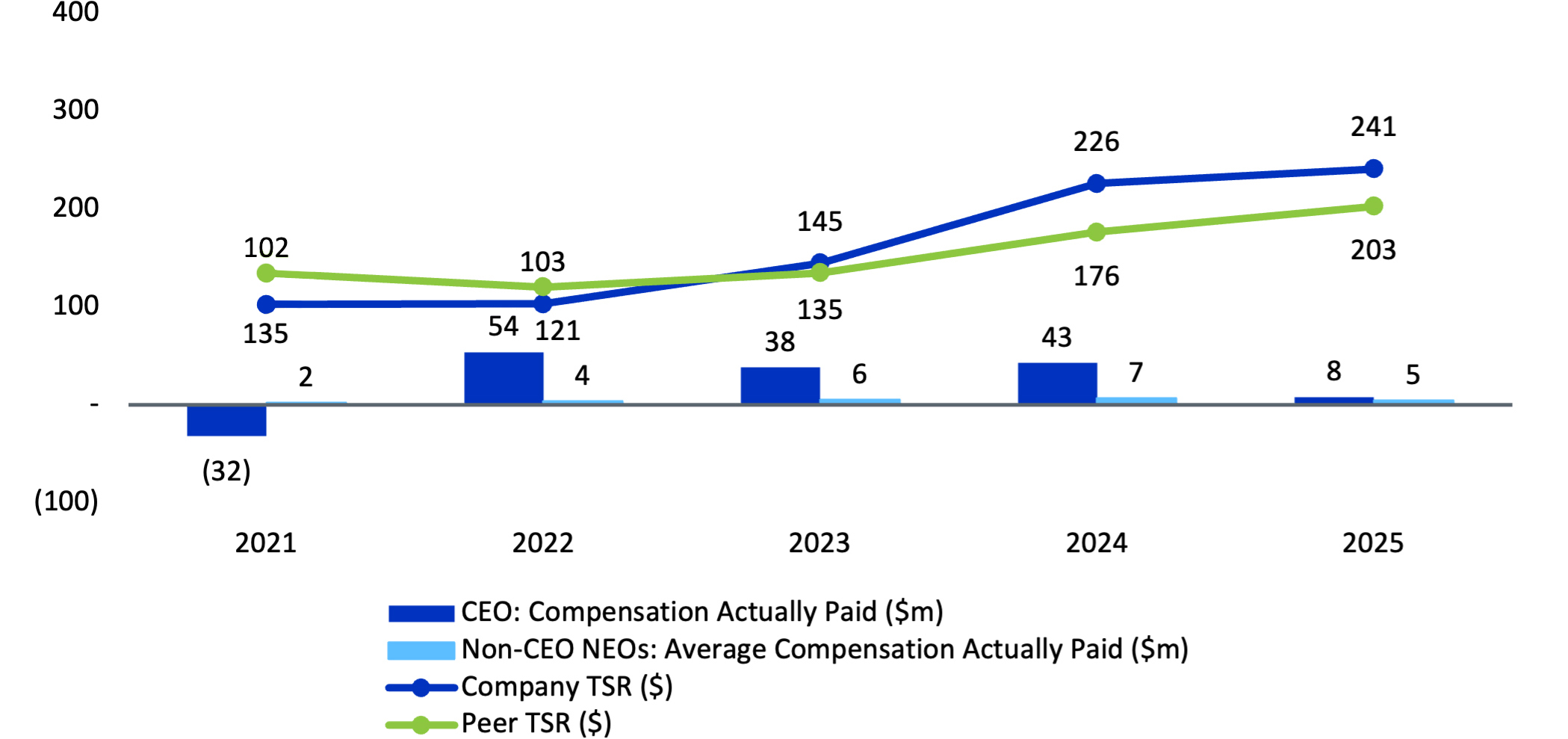
58 | | |||||||
| Executive Compensation | | ||||
Relationship Between Pay and Net Income
The following chart shows the relationship between (1) the compensation actually paid to our CEO and the average compensation actually paid to the non-CEO NEOs (each as calculated pursuant to Item 402(v)(2)(iii) of Regulation S-K) and (2) the net income of our company for the last five fiscal years.
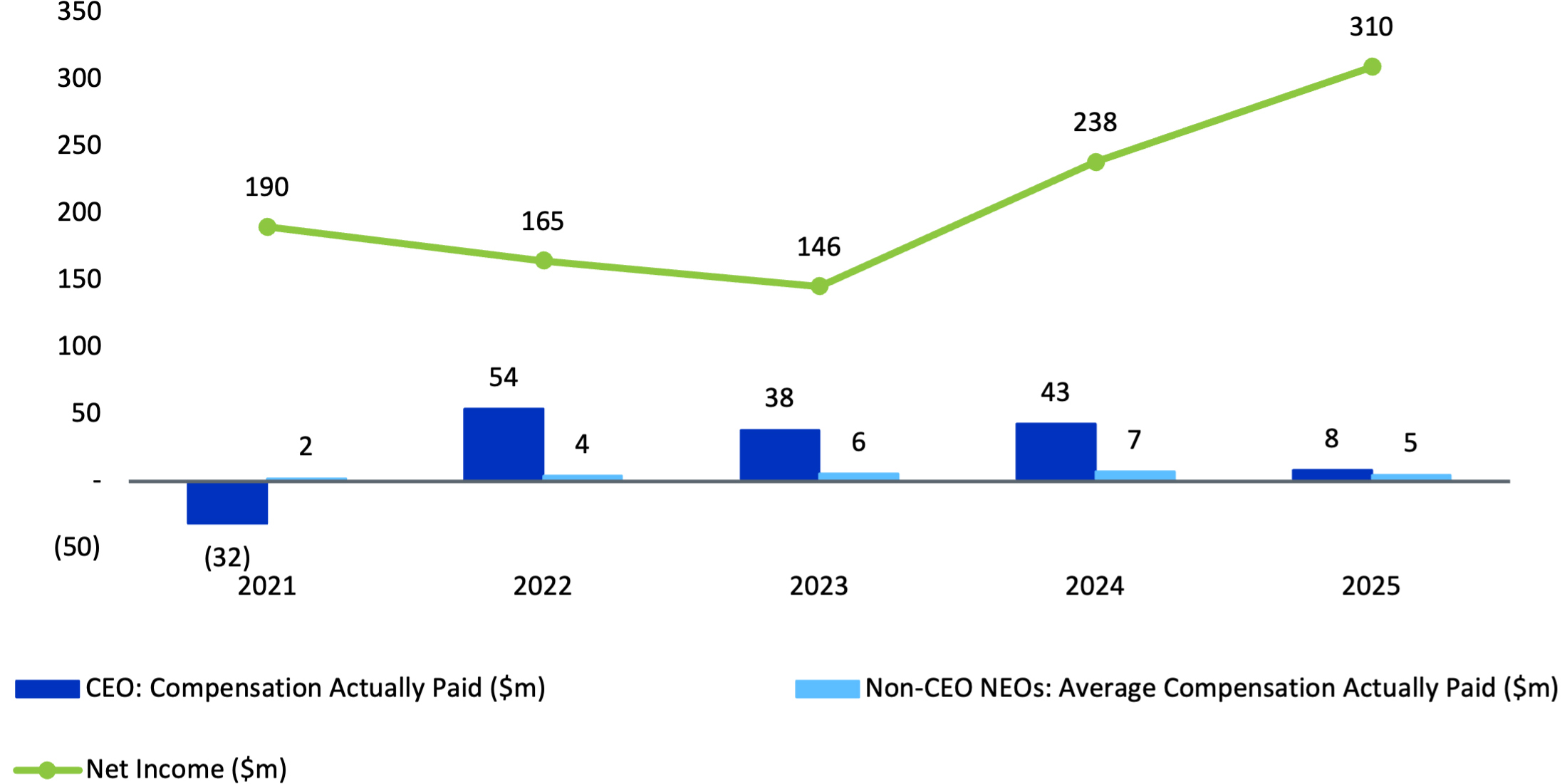
Relationship Between Pay and Share Price
The following chart shows the relationship between (1) the compensation actually paid to our CEO and the average compensation actually paid to the non-CEO NEOs (each as calculated pursuant to Item 402(v)(2)(iii) of Regulation S-K) and (2) Share Price for the last five fiscal years.
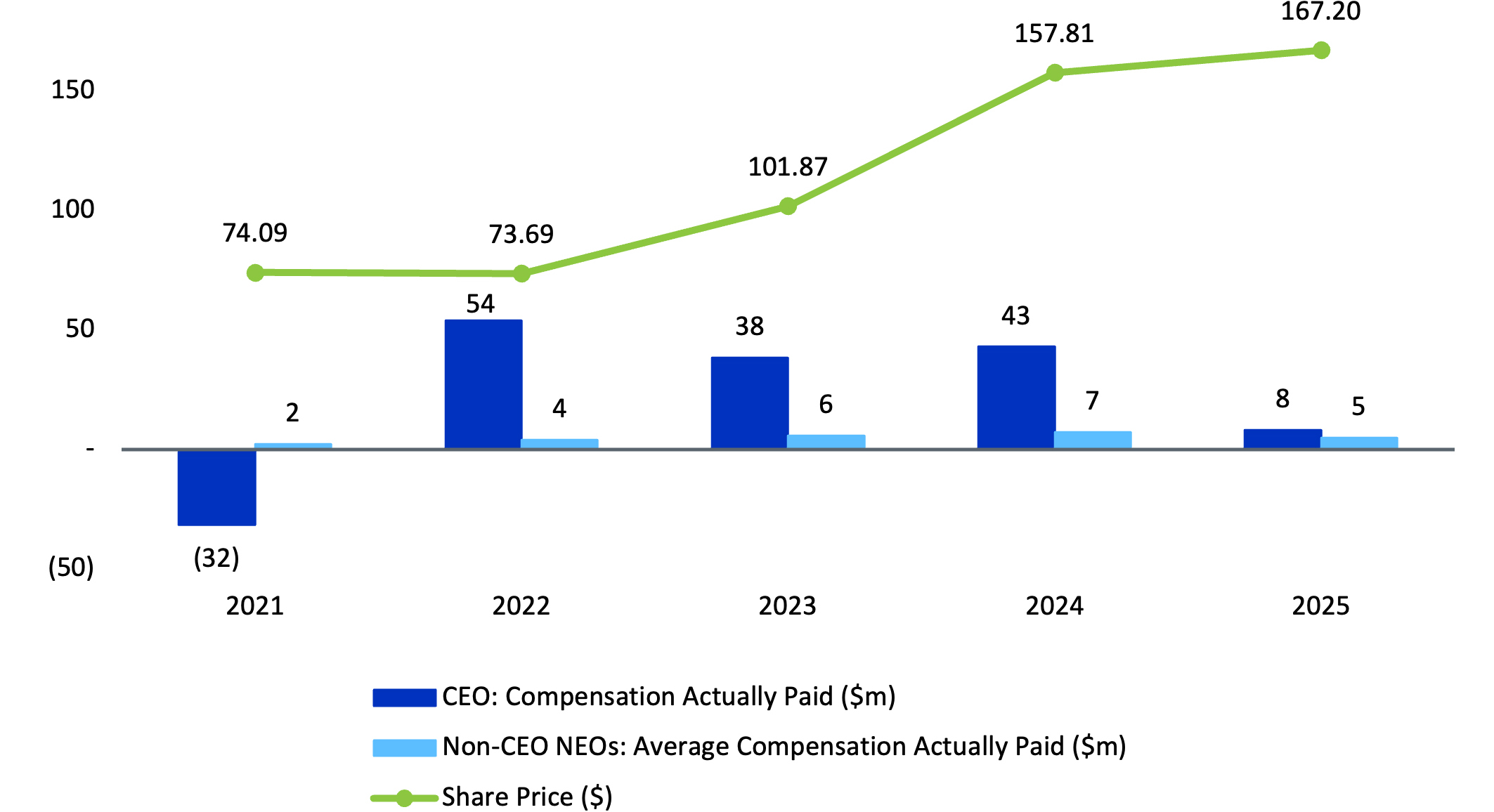
| 59 | |||||||
| Executive Compensation | | ||||
Tabular List: Performance Measures
In response to the Tabular List disclosure requirement pursuant to Item 402(v)(6) of Regulation S-K, the following table outlines four key performance measures, which our Compensation Committee considered, among others, when making executive compensation decisions for the performance year 2025. These measures are listed in alphabetical order, not reflective of order of importance. Share price is included in the pay versus performance table as our company-selected measure given its inclusion as a performance measure in Mr. Taubman’s performance-based equity awards reflected in compensation actually paid.
Consistent with our long-term focus, each of these elements are reviewed through a multi-year lens and considering our company’s business mix versus our competitors.
| Tabular List: Most Important Performance Measures | ||||||||
| 1. | ||||||||
| 2. | ||||||||
| 3. | ||||||||
| 4. | ||||||||
Equity Compensation Plan Information
The following table presents certain information about our equity compensation plans as of December 31, 2025:
| Plan Category | Number of Securities to be Issued upon Exercise of Outstanding Options, Warrants and Rights1 | Weighted Average Exercise Price of Outstanding Options, Warrants and Rights | Number of Securities Remaining Available for Future Issuance under Equity Compensation Plans Options, (Excluding Securities Reflected in the First Column)2 | |||||||||||||||||||||||
| Approved by Security Holders | ||||||||||||||||||||||||||
| Omnibus Incentive Plan | 20,711,320 | N/A | 12,288,680 | |||||||||||||||||||||||
| Not Approved by Security Holders | ||||||||||||||||||||||||||
| None | — | — | — | |||||||||||||||||||||||
1Consists of RSUs and LTIP Units granted under the Omnibus Incentive Plan, which do not have an exercise price. For purposes of this table, the number of shares issued includes all Performance LTIP Units, given that 100% of the performance condition hurdles have been achieved.
2Consists of shares of common stock or Partnership Units issuable under the Omnibus Incentive Plan pursuant to the terms and conditions of various awards that our Compensation Committee may make, including stock options, stock appreciation rights, restricted shares, RSUs, and other equity-based awards, including Partnership Units.
Security Ownership of Certain Beneficial Owners and Management
The following table sets forth, as of April 20, 2026, information regarding the beneficial ownership of our Class A common stock and Class B common stock and Partnership Units held by:
(1)each person, or group of affiliated persons, known by us to beneficially own more than 5% of any class of our outstanding voting securities;
(2)each of our directors;
(3)each of our Named Executive Officers; and
(4)all of our current directors and Named Executive Officers as a group.
60 | | |||||||
| Executive Compensation | | ||||
Percentage of beneficial ownership is based upon:
(1)25,849,598 shares of our Class A common stock issued and outstanding;
(2)40,029,326 Partnership Units outstanding, including 25,849,598 Partnership Units held by PJT Partners; and
(3)35,559,757 votes associated with Class A common stock and Class B common stock on director elections and removals and 39,989,623 votes associated with Class A common stock and Class B common stock on all other matters, in each case, as of April 20, 2026.
To our knowledge, except as set forth in the footnotes to this table, and subject to applicable community property laws, each person named in the table has sole voting and investment power with respect to the shares set forth opposite such person’s name. The number of shares of Class A common stock, Class B common stock, and Partnership Units shown as beneficially owned by each director and Named Executive Officer was determined in accordance with SEC rules, and the information is not necessarily indicative of beneficial ownership for any other purpose. Beneficial ownership includes any shares of Class A common stock as to which a person has the right to acquire within 60 days of April 20, 2026, through the delivery of shares of Class A common stock underlying RSUs. Except as otherwise indicated, the address of each of the directors and Named Executive Officers in this table is as follows: c/o PJT Partners Inc., 280 Park Avenue, New York, New York 10017.
| Name of Beneficial Owner | Shares of Class A Common Stock Beneficially Owned1 | Shares of Class B Common Stock Beneficially Owned2,3 (#) | Partnership Units Beneficially Owned1,2,3 | Combined Voting Power in Director Elections and Removals 2,3,4,5 (%) | Combined Voting Power in All Other Matters2,3,4,5 (%) | |||||||||||||||||||||||||||||||||||||||||||||
| (#) | % of Class | (#) | Class (%) | |||||||||||||||||||||||||||||||||||||||||||||||
| 5% Shareholders | ||||||||||||||||||||||||||||||||||||||||||||||||||
BlackRock, Inc.6 | 3,470,245 | 13.4 | — | — | — | 9.8 | 8.7 | |||||||||||||||||||||||||||||||||||||||||||
The Vanguard Group7 | 2,429,691 | 9.4 | — | — | — | 6.8 | 6.1 | |||||||||||||||||||||||||||||||||||||||||||
Stephen A. Schwarzman8 | 1,176,706 | 4.6 | 7 | 4,004,174 | 10.0 | 3.3 | 2.9 | |||||||||||||||||||||||||||||||||||||||||||
| Directors and Named Executive Officers | ||||||||||||||||||||||||||||||||||||||||||||||||||
| Paul J. Taubman | 400,000 | 1.5 | 1 | 5,424,000 | 13.6 | 18.7 | 27.4 | |||||||||||||||||||||||||||||||||||||||||||
| K. Don Cornwell | 26,710 | * | — | — | — | * | * | |||||||||||||||||||||||||||||||||||||||||||
James Costos9 | 12,864 | * | — | — | — | * | * | |||||||||||||||||||||||||||||||||||||||||||
| Peter L.S. Currie | — | * | — | — | — | * | * | |||||||||||||||||||||||||||||||||||||||||||
Emily K. Rafferty9 | 10,552 | * | — | — | — | * | * | |||||||||||||||||||||||||||||||||||||||||||
Thomas M. Ryan9,10 | 41,843 | * | — | — | — | * | * | |||||||||||||||||||||||||||||||||||||||||||
Grace R. Skaugen9 | 1,687 | * | — | — | — | * | * | |||||||||||||||||||||||||||||||||||||||||||
Kenneth C. Whitney9,11 | 12,010 | * | 2 | 122,150 | * | * | * | |||||||||||||||||||||||||||||||||||||||||||
Ji-Yeun Lee12 | 88,402 | * | 2 | 799,849 | 2.0 | 2.5 | 2.2 | |||||||||||||||||||||||||||||||||||||||||||
| Helen T. Meates | 66,466 | * | 1 | 201,345 | * | * | * | |||||||||||||||||||||||||||||||||||||||||||
| David A. Travin | 5,052 | * | 1 | 20,243 | * | * | * | |||||||||||||||||||||||||||||||||||||||||||
| Directors and Named Executive Officers as a Group (11 persons) | 665,586 | 2.6 | 7 | 6,567,586 | 16.4 | 22.6 | 30.9 | |||||||||||||||||||||||||||||||||||||||||||
*Represents less than one percent.
| 61 | |||||||
| Executive Compensation | | ||||
1Subject to the terms of the Exchange Agreement, the Partnership Units may be exchanged for cash equal to the then-current market value of an equal number of shares of our Class A common stock (determined in accordance with and subject to adjustment under the Exchange Agreement) or, at our election, for shares of our Class A common stock on a one-for-one basis, subject to customary conversion rate adjustments for splits, unit distributions, and reclassifications. See “Certain Relationships and Related Person Transactions — Exchange Agreement.” Beneficial ownership of Partnership Units reflected in this table has not been reflected as beneficial ownership of shares of our Class A common stock for which such units may be exchanged. Percentage of Partnership Units treats Partnership Units held by PJT Partners as outstanding.
2See “Shares to be Voted at the Annual Meeting; Our Voting Structure Does Not Contain Super-Voting Powers,” below.
3The voting power on applicable matters afforded to holders of Partnership Units by their shares of Class B common stock is automatically and correspondingly reduced as they exchange Partnership Units for cash or for shares of Class A common stock pursuant to the Exchange Agreement. If at any time the ratio at which Partnership Units are exchangeable for shares of Class A common stock changes from one-for-one as described under “Certain Relationships and Related Person Transactions—Exchange Agreement,” the number of votes to which Class B common shareholders are entitled on applicable matters will be adjusted accordingly.
4Represents percentage of voting power of the Class A common stock and Class B common stock voting together as a single class.
5In connection with the merger and spin-off transactions, the senior management of Blackstone Inc. (the "Former Parent"), including Mr. Stephen A. Schwarzman and all of the Former Parent’s other executive officers (the “Former Parent's Senior Management”) provided an irrevocable proxy to Mr. Taubman, empowering Mr. Taubman to vote or cause to be voted all of the shares of Class B common stock then or thereafter held by the Former Parent's Senior Management (the “Subject Shares”) at every shareholders meeting of our company on all matters in respect to which the Subject Shares are entitled to vote, and on every action or approval by written consent of the shareholders of our company in respect of which the Subject Shares are entitled to consent or dissent, for so long as Mr. Taubman is the CEO of PJT Partners. The combined voting power information in this table gives effect to such irrevocable proxy.
6Based solely on information provided on a Schedule 13G/A filed with the SEC on July 17, 2025. BlackRock, Inc. has sole voting power over 3,431,683 shares of our Class A common stock and sole dispositive power over 3,470,245 shares of our Class A common stock. The business address of BlackRock, Inc. is 50 Hudson Yards, New York, New York 10001.
7Based solely on information provided on a Schedule 13G/A filed with the SEC on January 10, 2024. The Vanguard Group, Inc. has shared voting power over 43,318 shares of our Class A common stock, shared dispositive power over 63,649 shares of our Class A common stock and sole dispositive power over 2,366,042 shares of our Class A common stock. On March 27, 2026, The Vanguard Group filed a Schedule 13 G/A in connection with an internal reorganization that reported beneficial ownership of 0.0% of our common stock as of March 13, 2026. In the March 27, 2026 Schedule 13 G/A, The Vanguard Group noted that certain subsidiaries or business divisions of subsidiaries of The Vanguard Group that formerly had, or were deemed to have, beneficial ownership with The Vanguard Group, will report beneficial ownership (on a disaggregated basis) from The Vanguard Group. The business address of The Vanguard Group is 100 Vanguard Boulevard, Malvern, Pennsylvania, 19355.
8The business address of Mr. Schwarzman is c/o Blackstone Inc., 345 Park Avenue, New York, New York 10154.
9Includes 1,781, 1,425, 2,374, 1,187, and 1,187 shares of Class A common stock as to which Mr. Costos, Ms. Rafferty, Mr. Ryan, Ms. Skaugen, and Mr. Whitney, respectively, have the right to acquire within 60 days of April 20, 2026, through delivery of shares of Class A common stock underlying RSUs.
10Includes 7 shares of Class A common stock held in a trust for which Mr. Ryan’s wife is the investment trustee.
11Includes 1 share of Class B common stock and 6,750 Partnership Units held in a trust for which Mr. Whitney is the investment trustee.
12Includes 1 share of Class B common stock and 100,000 Partnership Units beneficially owned by Ms. Lee’s children, for which Ms. Lee disclaims beneficial ownership.
Delinquent Section 16(a) Reports
Section 16(a) of the Exchange Act requires our directors and certain officers to file initial reports of share ownership and reports of changes in share ownership with the SEC. Based solely on our review of copies of such reports, we believe that all Section 16(a) filing requirements applicable to our directors and officers were complied with during 2025, other than a single Form 4 reporting two transactions for Peter L.S. Currie that was filed late due to an administrative delay in receiving EDGAR codes required to make such a filing.
Certain Relationships and Related Person Transactions
Our Board has adopted a written statement of policy regarding transactions with related persons, which we refer to as our “related person policy.” Our related person policy requires that a “related person” (as defined as in paragraph (a) of Item 404 of Regulation S-K) must promptly disclose to our General Counsel, or such other person designated by our Board, any “related person transaction” (defined as any transaction that is anticipated would be reportable by us under Item 404(a) of Regulation S-K in which we were or are to be a participant and the amount involved exceeds $120,000 and in which any related person had or will have a
62 | | |||||||
| Executive Compensation | | ||||
direct or indirect material interest) and all material facts with respect thereto. The General Counsel, or such other person, will then promptly communicate that information to our Board. No related person transaction will be executed without the approval or ratification of our Board or a duly authorized committee of our Board. It is our policy that directors interested in a related person transaction will recuse themselves from any vote on a related person transaction in which they have an interest.
Exchange Agreement
We have entered into the Exchange Agreement dated as of October 1, 2015, among PJT Partners Inc., PJT Partners Holdings LP, and the Partnership Unitholders from time to time party thereto (as amended, the “Exchange Agreement”) with the limited partners of PJT Partners Holdings pursuant to which they (or certain permitted transferees) have the right, subject to the terms and conditions set forth in the Third Amended and Restated Limited Partnership Agreement of PJT Partners Holdings LP, as amended (the “Limited Partnership Agreement”), on a quarterly basis, to exchange all or part of their Partnership Units. Further, pursuant to the terms in the Limited Partnership Agreement, our company may also require Partnership Unitholders who are not Service Providers (as defined in the Limited Partnership Agreement) to exchange such Partnership Units. We retain the sole option to determine whether to settle the exchange in either cash or for shares of our Class A common stock on a one-for-one basis, subject to customary conversion rate adjustments for splits, unit distributions, and reclassifications. The price per Partnership Unit to be received in a cash-settled exchange will be equal to the fair value of a share of our Class A common stock (determined in accordance with and subject to adjustment under the Exchange Agreement). In the event cash-settled exchanges of Partnership Units are funded with new issuances of our Class A common stock, the fair value of a share of our Class A common stock will be deemed to be equal to the net proceeds per share of our Class A common stock received by PJT Partners in the related issuance. Accordingly, in this event, the price per Partnership Unit to which an exchanging holder of Partnership Units will be entitled may be greater than or less than the then-current market value of our Class A common stock. The Exchange Agreement also provides that a holder of Partnership Units will not have the right to exchange Partnership Units in the event that PJT Partners determines that such exchange would be prohibited by law, or would result in any breach of any debt agreement or other material contract of PJT Partners or PJT Partners Holdings. The Exchange Agreement also provides our company with the ability to decline to exchange should it determine that the exchange would cause unreasonable financial burden on PJT Partners Holdings, as determined by our Board. The registration rights agreement does not contain any penalties associated with failure to file or to maintain the effectiveness of a registration statement covering the shares owned by individuals covered by such agreement.
Pursuant to the terms of the Exchange Agreement, and as previously reported in SEC Form 4 filings, three of our Named Executive Officers submitted elections to exchange Partnership Units over the course of various quarterly exchanges in fiscal year 2025, as follows: Paul J. Taubman, our Chairman and Chief Executive Officer, exchanged a total of 360,000 Partnership Units; Ji-Yeun Lee, our Managing Partner, exchanged a total of 83,500 Partnership Units; and David A. Travin, our General Counsel, exchanged a total of 2,500 Partnership Units. As determined by our Board, these exchanges were settled for cash in amounts that totaled approximately $59.7 million, $13.6 million, and $0.4 million, respectively.
Registration Rights Agreement
We have entered into a registration rights agreement with the limited partners of PJT Partners Holdings pursuant to which we granted them, their affiliates, and certain of their transferees the right, under certain circumstances and subject to certain restrictions, to require us to register under the Securities Act shares of Class A common stock delivered in exchange for Partnership Units. The registration rights agreement does not contain any penalties associated with failure to file or to maintain the effectiveness of a registration statement covering the shares owned by individuals covered by such agreement.
In addition, in the event that any holder or group of holders elects to exchange Partnership Units with a cash value of at least $75 million (determined in accordance with the registration rights agreement) in
| 63 | |||||||
| Executive Compensation | | ||||
respect of any quarterly exchange date, a demand committee comprised of certain holders of Partnership Units will have the right to request that we facilitate a registered underwritten offering with respect to:
(1)the sale by such holder(s) of Class A common stock delivered to such holder(s) in exchange for such Partnership Units (in the event that we elect to settle such exchange in shares of Class A common stock) or
(2)the sale by us of Class A common stock to fund the cash-settled exchanges of such Partnership Units (in the event that we elect to settle such exchange in cash); provided, however, that we will not be obligated to effect any such requested registration within 180 days after the effective date of a previous registration pursuant to the registration rights agreement.
In addition, we have the right to defer effecting a demand for a maximum of 60 days in certain circumstances, not to exceed 90 days in any 365-day period, including if such demand could materially interfere with a bona fide business or financing transaction.
Holders of Partnership Units also have the ability to exercise certain piggyback registration rights in respect of registered offerings requested by other registration rights holders or initiated by us, subject to customary cut-back provisions.
Tax Receivable Agreement
Holders of Partnership Units (other than PJT Partners) have the right, subject to the terms and conditions set forth in the Limited Partnership Agreement of PJT Partners Holdings, on a quarterly basis (subject to the terms of the Exchange Agreement) to exchange all or part of their Partnership Units. Further, pursuant to the terms in the Limited Partnership Agreement, our company may also require Partnership Unitholders who are not Service Providers (as defined in the Limited Partnership Agreement) to exchange such Partnership Units. PJT Partners Holdings has made an election under Section 754 of the Internal Revenue Code of 1986 (the “Code”) effective for each taxable year in which an exchange of Partnership Units for cash or for shares of Class A common stock occurs, which is expected to result in increases to the tax basis of the assets of PJT Partners Holdings at the time of an exchange of Partnership Units. Stock-settled exchanges and certain of these cash-settled exchanges are expected to result in increases in the tax basis of the tangible and intangible assets of PJT Partners Holdings. These increases in tax basis may reduce the amount of tax that PJT Partners would otherwise be required to pay in the future. These increases in tax basis may also decrease gains (or increase losses) on future dispositions of certain capital assets to the extent tax basis is allocated to those capital assets. The Internal Revenue Service (the “IRS”) may challenge all or part of the tax basis increase and increased deductions, and a court could sustain such a challenge.
We have entered into a tax receivable agreement with the holders of Partnership Units (other than PJT Partners) that provides for the payment by PJT Partners to exchanging holders of Partnership Units of 85% of the benefits, if any, that PJT Partners is deemed to realize as a result of the increases in tax basis related to such exchanges of Partnership Units and of certain other tax benefits related to entering into the tax receivable agreement, including tax benefits attributable to payments under the tax receivable agreement. This payment obligation is an obligation of PJT Partners and not of PJT Partners Holdings. PJT Partners expects to benefit from the remaining 15% of cash tax savings, if any, in income tax it realizes. For purposes of the tax receivable agreement, the cash tax savings in income tax is computed by comparing the actual income tax liability of PJT Partners (calculated with certain assumptions) to the amount of such taxes that PJT Partners would have been required to pay had there been no increase to the tax basis of the assets of PJT Partners Holdings as a result of the exchanges and had PJT Partners not entered into the tax receivable agreement. The term of the tax receivable agreement continues until all such tax benefits have been utilized or expired, unless PJT Partners exercises its right to terminate the tax receivable agreement for an amount based on the agreed payments remaining to be made under the agreement (as described in more detail below) or PJT Partners breaches any of its material obligations under the tax receivable agreement in which case all obligations generally will be accelerated and due as if PJT Partners had exercised its right to terminate the tax receivable agreement. Estimating the amount of payments that may be made under the tax
64 | | |||||||
| Executive Compensation | | ||||
receivable agreement is by its nature imprecise, insofar as the calculation of amounts payable depends on a variety of factors. The actual increase in tax basis, as well as the amount and timing of any payments under the tax receivable agreement, will vary depending upon a number of factors, including:
>the timing of exchanges — for instance, the increase in any tax deductions will vary depending on the fair market value, which may fluctuate over time, of the depreciable or amortizable assets of PJT Partners Holdings at the time of each exchange;
>the price of shares of our Class A common stock at the time of the exchange — the increase in any tax deductions, as well as the tax basis increase in other assets, of PJT Partners Holdings, is directly proportional to the cash price for the applicable Partnership Units (in the case of a cash-settled exchange) or the price of shares of our Class A common stock at the time of the exchange (in the case of a stock-settled exchange);
>the extent to which such exchanges are taxable — if an exchange is not taxable for any reason, increased deductions will not be available; and
>the amount and timing of our income — PJT Partners is required to pay 85% of the cash tax savings as and when realized, if any. If PJT Partners does not have taxable income, PJT Partners is not generally required (absent a change of control or circumstances requiring an early termination payment) to make payments under the tax receivable agreement for that taxable year because no cash tax savings will have been realized. However, any cash tax savings that do not result in realized benefits in a given tax year will likely generate tax attributes that may be utilized to generate benefits in previous or future tax years. The utilization of such tax attributes will result in payments under the tax receivables agreement.
We will account for the effects of these increases in tax basis and associated payments under the tax receivable agreement arising from exchanges as follows:
>we record an increase in deferred tax assets for the estimated income tax effects of the increases in tax basis based on enacted federal, state, and local tax rates at the date of the exchange;
>to the extent we estimate that we will not realize the full benefit represented by the deferred tax asset, based on an analysis that will consider, among other things, our expectation of future earnings, we reduce the deferred tax asset with a valuation allowance; and
>we record 85% of the estimated realizable tax benefit (which is the recorded deferred tax asset less any recorded valuation allowance) as an increase to the amount due pursuant to the tax receivable agreement and the remaining 15% of the estimated realizable tax benefit as an increase to additional paid-in capital.
The effects of changes in estimates after the date of the redemption or exchange as well as subsequent changes in the enacted tax rates are included in net income.
We expect that as a result of the size of the transfers and increases in the tax basis of the tangible and intangible assets of PJT Partners Holdings, the payments that we may make under the tax receivable agreement will be substantial. There may be a material negative effect on our liquidity if, as a result of timing discrepancies or otherwise, the payments under the tax receivable agreement exceed the actual cash tax savings that PJT Partners realizes in respect of the tax attributes subject to the tax receivable agreement and/or distributions to PJT Partners by PJT Partners Holdings are not sufficient to permit PJT Partners to make payments under the tax receivable agreement after it has paid taxes. Late payments under the tax receivable agreement generally will accrue interest at an uncapped rate equal to SOFR plus 500 basis points. The payments under the tax receivable agreement are not conditioned upon continued ownership of us by holders of Partnership Units.
In addition, the tax receivable agreement provides that upon certain changes of control, PJT Partners’ (or its successor’s) obligations with respect to acquired or exchanged Partnership Units (whether acquired or exchanged before or after such transaction) would be based on certain assumptions, including that PJT Partners would have sufficient taxable income to fully utilize the deductions arising from the
| 65 | |||||||
| Executive Compensation | | ||||
increased tax deductions and tax basis and other benefits related to entering into the tax receivable agreement.
Furthermore, PJT Partners may elect to terminate the tax receivable agreement early by making an immediate payment equal to the present value of the anticipated future cash tax savings. In determining such anticipated future cash tax savings, the tax receivable agreement includes several assumptions, including:
(1)that any Partnership Units that have not been exchanged are deemed exchanged for the market value of the shares of Class A common stock at the time of termination;
(2)PJT Partners will have sufficient taxable income in each future taxable year to fully realize all potential tax savings;
(3)the tax rates for future years will be those specified in the law as in effect at the time of termination; and
(4)certain non-amortizable assets are deemed disposed of within specified time periods. In addition, the present value of such anticipated future cash tax savings are discounted at a rate equal to SOFR plus 100 basis points.
As a result of the change in control provisions and the early termination right, PJT Partners could be required to make payments under the tax receivable agreement that are greater than the specified percentage of the actual cash tax savings that PJT Partners realizes in respect of the tax attributes subject to the tax receivable agreement. In these situations, our obligations under the tax receivable agreement could have a substantial negative impact on our liquidity.
Decisions made by our officers and directors in the course of running our business may influence the timing and amount of payments that are received by an exchanging or selling existing owner under the tax receivable agreement. For example, the earlier disposition of assets following an acquisition or exchange transaction generally will accelerate payments under the tax receivable agreement and increase the present value of such payments, and the disposition of assets before an acquisition or exchange transaction will increase an existing owner’s tax liability without giving rise to any rights of an existing owner to receive payments under the tax receivable agreement.
Payments under the tax receivable agreement are based on the tax reporting positions that we determine. PJT Partners will not be reimbursed for any payments previously made under the tax receivable agreement if a tax basis increase is successfully challenged by the IRS. As a result, in certain circumstances, payments could be made under the tax receivable agreement in excess of PJT Partners’ cash tax savings.
The Limited Partnership Agreement
PJT Partners holds Partnership Units in PJT Partners Holdings and is the sole general partner of PJT Partners Holdings. Accordingly, PJT Partners operates and controls all of the business and affairs and consolidates the financial results of PJT Partners Holdings and its operating subsidiaries and, through PJT Partners Holdings and its operating subsidiaries, conducts our business.
The Limited Partnership Agreement provides that substantially all expenses incurred by or attributable to PJT Partners, but not including obligations incurred under the tax receivable agreement by PJT Partners, income tax expenses of PJT Partners, and payments on indebtedness incurred by PJT Partners, are borne by PJT Partners Holdings.
Pursuant to the Limited Partnership Agreement, PJT Partners has the right to determine when distributions will be made to holders of Partnership Units and the amount of any such distributions (other than tax distributions described below). If a distribution is authorized, such distribution will be made to the holders of Partnership Units pro rata in accordance with the percentages of their respective partnership interests that are entitled to participate in distributions.
66 | | |||||||
| Executive Compensation | | ||||
The holders of Partnership Units, including PJT Partners, will incur U.S. federal, state, and local income taxes on their proportionate share of any taxable income of PJT Partners Holdings. Except for the priority allocations of income in respect of LTIP Units described below, net profits and net losses of PJT Partners Holdings will generally be allocated to its holders (including PJT Partners) pro rata in accordance with the percentages of their respective partnership interests, except as otherwise required by law. In accordance with the Limited Partnership Agreement, we intend to cause PJT Partners Holdings to make pro rata cash distributions, to the extent of available cash, to the holders of the partnership interests in PJT Partners Holdings in amounts equal to 50% of the taxable income allocated to such holders for purposes of funding their tax obligations in respect of the income of PJT Partners Holdings that is allocated to them.
For 2025, Mr. Taubman, Mr. Whitney, Ms. Lee, Ms. Meates, and Mr. Travin received $15,131,471, $408,237, $2,188,913, $508,090, and $56,729 respectively, as distributions on their Partnership Units.
The Limited Partnership Agreement provides that PJT Partners may not engage in, or cause or permit, a Termination Transaction (as defined below), other than with the consent of limited partners holding a majority of all the outstanding Partnership Units (other than Partnership Units held by PJT Partners and entities controlled by PJT Partners), including each limited partner that held, immediately following the closing of the merger and spin-off transactions in 2015, and, as of any subsequent date of determination, holds, not less than five percent (5%) of the total number of Partnership Units then outstanding (a “Significant Limited Partner”), or if the requirements discussed below are satisfied. A “Termination Transaction” means any direct or indirect transfer of all or any portion of PJT Partners’ interest in PJT Partners Holdings in connection with, or any other occurrence of:
>a merger, consolidation or other combination transaction involving PJT Partners;
>a sale, lease, exchange, or other transfer of all or substantially all of the assets of PJT Partners not in the ordinary course of business, whether in a single transaction or a series of related transactions;
>a reclassification, recapitalization, or change of the outstanding shares of our Class A common stock (other than a change in par value, or from par value to no par value, or as a result of a stock split, stock dividend, or similar subdivision, including in connection with the distribution, exchange, redemption, or exercise of rights under our shareholder rights agreement or securities issuable in respect of such rights);
>the adoption of any plan of liquidation or dissolution of PJT Partners; or
>any other direct or indirect transfer of all or any portion of PJT Partners’ interest in PJT Partners Holdings, other than certain permitted transfers to affiliated entities.
Such consent of limited partners to a Termination Transaction is not required if either:
(1)in connection with the Termination Transaction:
(i)each holder of Partnership Units is entitled to receive the “transaction consideration,” defined as the fair market value, at the time of the Termination Transaction, of an amount of cash, securities, or other property equal to the product of:
>the number of shares of our Class A common stock into which a Partnership Unit is then exchangeable and
>the greatest amount of cash, securities, or other property paid per share to the holder of any shares of our Class A common stock in consideration of such shares in connection with the Termination Transaction;
provided that, if, in connection with the Termination Transaction, a purchase, tender, or exchange offer is made to and accepted by the holders of a majority of the outstanding shares of our Class A common stock, the transaction consideration will refer to the fair market value of the greatest amount of cash, securities, or other property which such holder would have received had it exercised its exchange right and received shares of our Class A common stock in exchange for its Partnership Units immediately prior to the expiration of such purchase, tender, or exchange offer and had accepted such purchase, tender, or exchange offer; and
| 67 | |||||||
| Executive Compensation | | ||||
(ii)PJT Partners Holdings receives an opinion from nationally recognized tax counsel to the effect that such Termination Transaction will be tax-free to each holder of Partnership Units (other than PJT Partners and entities controlled by PJT Partners) for U.S. federal income tax purposes (except to the extent of cash received),
or
(2)all of the following conditions are met:
>substantially all of the assets directly or indirectly owned by PJT Partners Holdings prior to the announcement of the Termination Transaction are, immediately after the Termination Transaction, owned directly or indirectly by (x) PJT Partners Holdings or (y) another limited partnership or limited liability company organized or existing under the laws of the United States, any state thereof, the District of Columbia, or any territory thereof, which is the survivor of a merger, consolidation, or combination of assets with PJT Partners Holdings, which we refer to as the “surviving partnership”;
>the surviving partnership is classified as a partnership for U.S. federal income tax purposes;
>each holder of Partnership Units (other than PJT Partners and entities controlled by PJT Partners) that held Partnership Units immediately prior to the closing of such Termination Transaction owns a percentage interest of the surviving partnership based on the relative fair market value of the net assets of PJT Partners Holdings and the other net assets of the surviving partnership immediately prior to the consummation of such transaction; and
>the rights of such limited partners with respect to the surviving partnership are at least as favorable as those of limited partners prior to the consummation of such transaction and as those applicable to any other limited partners or non-managing members of the surviving partnership, and such rights include:
(a)if PJT Partners or its successor has a single class of publicly traded common equity securities, the right, to the same extent provided to holders of Partnership Units pursuant to the Exchange Agreement, to exchange their interests in the surviving partnership for either:
(1)a number of such publicly traded common equity securities with a fair market value, as of the date of consummation of such Termination Transaction, equal to the transaction consideration referred to above, subject to customary conversion rate adjustments for splits, unit distributions and reclassifications, which we refer to as the “successor shares amount” or
(2)cash in an amount equal to the fair market value of the successor shares amount at the time of such exchange or
(b)if PJT Partners or its successor does not have a single class of publicly traded common equity securities, the right to exchange their interests in the surviving partnership on a quarterly basis for cash in an amount equal to the fair market value of such interest at the time of exchange, as determined at least once every calendar quarter by an independent appraisal firm of recognized national standing retained by the surviving partnership.
For the purpose of determining compliance with the condition set forth in the third bullet above, the relative fair market values shall be reasonably determined by PJT Partners as of the time of such transaction and, to the extent applicable, shall be no less favorable to the holders of Partnership Units than the relative values reflected in the terms of such transaction.
The Limited Partnership Agreement also provides the limited partners with certain consent rights in the event a majority of our Board ceases to be Continuing Directors (as defined below) (such event, a “Board Change of Control”). “Continuing Directors” means as of any date of determination, any member of our Board who:
(1)was a member immediately following the consummation of the merger and spin-off transactions in 2015 or
68 | | |||||||
| Executive Compensation | | ||||
(2)was nominated for election or elected or appointed with the approval of a majority of the Continuing Directors who were members at the time of such nomination, election, or appointment, but excluding, for this purpose, any such individual whose initial assumption of office occurs as a result of an actual or threatened election contest with respect to the election or removal of directors or other actual or threatened solicitation of proxies or consents by or on behalf of a person other than our Board. From and after the occurrence of a Board Change of Control, the following actions will require the approval of limited partners representing a majority in interest of all limited partners (excluding any limited partners controlled by PJT Partners), including each Significant Limited Partner:
>any removal or appointment of any “officer,” as defined in Rule 16a-1(f) of the Exchange Act, including the CEO, of PJT Partners;
>the creation, authorization, or issuance of any new class or series of equity interest in PJT Partners Holdings;
>the incurrence of any indebtedness (other than intercompany indebtedness) by PJT Partners Holdings or any of its subsidiaries or controlled affiliates that would, or is intended to, result in a material increase in the amount of consolidated indebtedness of PJT Partners Holdings as compared to immediately prior to such Board Change of Control;
>any extraordinary distribution of PJT Partners Holdings;
>any change in PJT Partners Holdings’ distribution policy that would, or that is intended to, result in a material increase in the amount or frequency of distributions as compared to levels prior to our Board Change of Control;
>any change in PJT Partners Holdings’ policy regarding Partnership Unit repurchases including without limitation from PJT Partners, that would, or that is intended to, result in a material increase in the amount or frequency of Partnership Unit repurchases as compared to levels prior to our Board Change of Control;
>any merger, consolidation, or sale of all or any significant portion of the assets of PJT Partners Holdings;
>any voluntary liquidation, dissolution, or winding up of PJT Partners Holdings or the commencement of a proceeding for bankruptcy, insolvency, receivership, or similar action with respect to the PJT Partners Holdings or any of its subsidiaries or controlled affiliates;
>calling any meeting of the limited partners of PJT Partners Holdings or submitting any matter for the vote or consent of the limited partners of PJT Partners Holdings;
>any settlement or compromise of any litigation directly against or otherwise relating to indemnification of the PJT Partners or its directors or officers or their affiliates or representatives or any litigation regarding tax matters; or
>any amendment to the Limited Partnership Agreement.
In addition, the Limited Partnership Agreement enables PJT Partners Holdings to issue LTIP Units pursuant to the Omnibus Incentive Plan. LTIP Units are a class of partnership interest that are intended to qualify as “profits interests” in PJT Partners Holdings for U.S. federal income tax purposes that, subject to certain conditions, shall automatically be converted into Partnership Units. LTIP Units initially do not have full parity, on a per unit basis, with Partnership Units with respect to liquidating distributions. Upon the occurrence of specified events, LTIP Units can over time achieve full parity with Partnership Units, at which time LTIP Units shall automatically be converted into Partnership Units on a one-for-one basis. The Limited Partnership Agreement provides that upon a sale of all or substantially all of the assets of PJT Partners Holdings, holders of LTIP Units will receive a priority allocation of income. The priority allocation will generally be made to the holders of LTIP Units until the capital account of each LTIP Unit equals the capital account of a Partnership Unit. In addition, the capital accounts of the LTIP Units will be increased in priority to the Partnership Units when PJT Partners Holdings revalues its assets. After the capital account balances of the LTIP Units have been increased such that each LTIP Unit has a capital account balance equal to that of a
| 69 | |||||||
| Executive Compensation | | ||||
Partnership Unit, allocations of net income and net loss are made on a per-unit basis. The effect of these allocation provisions is to enable LTIP Units, which are issued with lower capital account balances than the Partnership Units, to participate in liquidating distributions of PJT Partners Holdings on the same basis as Partnership Units, assuming there is sufficient profit to allocate to the LTIP Units.
LTIP Units may be issued to PJT Partners personnel and third parties from time to time in one or more series having the rights, powers, privileges, restrictions, qualifications, and limitations set forth in the relevant award agreement or other documentation pursuant to which the LTIP Units of such series are granted or issued, including with respect to participation in distributions.
Subject to the terms of any award or other applicable agreement, unvested partnership interests will be forfeited if the holder ceases to provide services to PJT Partners Holdings. Certain forfeited partnership interests will be subject to reallocation by our Compensation Committee in consultation with Mr. Taubman (or subject to other reallocations in accordance with the Limited Partnership Agreement).
Sublease with Dynasty Equity Partners Management, LLC
PJT Partners Holdings has entered into a sublease agreement (the “Sublease”) with Dynasty Equity Partners Management, LLC, a Delaware limited liability company (“Dynasty”), to sublease a portion of our company's office space to Dynasty. K. Don Cornwell, a member of our Board, is the Chief Executive Officer and co-founder of Dynasty. The Sublease commenced on October 1, 2022 with an initial term of two years and an option to extend for an additional year, which was subsequently exercised. During the third quarter of 2025, the Sublease was amended to further extend the term through June 30, 2026. For fiscal year 2025, the annual payments by Dynasty under the Sublease totaled approximately $0.9 million. The rent, terms, and conditions of the Sublease were consistent with those similar to subleases in the market as of the time the Sublease was entered or extended.
70 | | |||||||
| |||||
Audit Matters
| Proposal 3: Ratification of Independent Registered Public Accounting Firm | ||||||||
Our Audit Committee of our Board has selected Deloitte & Touche LLP as our independent registered public accounting firm to perform the audit of our consolidated financial statements for 2026. | ||||||||
| Board Recommendation | ||||||||
| Our Board recommends that you vote “FOR” the ratification of the selection of Deloitte & Touche LLP as our independent registered public accounting firm. | ||||||||
Ratification of Independent Registered Public Accounting Firm
Our Audit Committee has selected Deloitte as our independent registered public accounting firm to perform the audit of our consolidated financial statements for 2026. Representatives of Deloitte are expected to be present at our Annual Meeting, will have an opportunity to make a statement if they so desire and will be available to respond to appropriate questions.
Board Recommendation
The appointment of Deloitte as our independent registered public accounting firm is being submitted to our shareholders for ratification at the Annual Meeting. Our Board recommends that the shareholders vote “FOR” the ratification of the selection of Deloitte as our independent registered public accounting firm. The submission of the appointment of Deloitte is required neither by law nor by our Amended and Restated By-Laws. Our Board is nevertheless submitting it to our shareholders to ascertain their views. If our shareholders do not ratify the appointment, the selection of another independent registered public accounting firm may be considered by our Audit Committee. Even if the selection is ratified, our Audit Committee in its discretion may select a different independent registered public accounting firm at any time during the year if it determines that such a change would be in the best interests of our company and our shareholders.
| 71 | |||||||
| Audit Matters | | ||||
Audit Fees
The following table sets forth aggregate fees billed to us by Deloitte for the years ended December 31, 2025 and 2024:
| Year Ended December 31, | |||||||||||||||||
| 2025 | 2024 | ||||||||||||||||
Audit Fees1 | $ | 2,543,042 | $ | 1,933,213 | |||||||||||||
| Audit-Related Fees | — | — | |||||||||||||||
Tax Fees2 | 1,138,370 | 1,205,678 | |||||||||||||||
All Other Fees3 | 2,063 | 20,641 | |||||||||||||||
| Total | $ | 3,683,475 | $ | 3,159,532 | |||||||||||||
1Audit Fees represent fees for services rendered for the audit and quarterly reviews of our consolidated financial statements, audit of the effectiveness of internal control over financial reporting as required by Section 404 of the Sarbanes-Oxley Act, and statutory and financial audits for our United States and foreign consolidated subsidiaries.
2Tax fees represent fees for services performed by Deloitte’s tax personnel, except those services specifically related to the audit and review of the financial statements, and consisted of tax consulting and compliance professional services, including to our United States and foreign consolidated subsidiaries.
3All Other Fees represent fees for subscriptions to Deloitte's accounting research tool and other related services.
Pre-Approval Policies and Procedures
Our Audit Committee does not permit the engagement of our auditors without pre-approval by our Audit Committee. The engagement of Deloitte for permitted non-audit accounting and tax services is limited to circumstances where these services are considered integral to the audit services that Deloitte provides or where there is another compelling rationale for using Deloitte. All audit services for which Deloitte was engaged during 2025 were pre-approved by our Audit Committee in compliance with applicable SEC requirements.
72 | | |||||||
| Audit Matters | | ||||
REPORT OF OUR AUDIT COMMITTEE
The duties and responsibilities of our Audit Committee are set forth in our Audit Committee Charter, which can be found on our website, www.pjtpartners.com, under the “Investors/Corporate Governance/Governance Documents” section.
Our Audit Committee has:
>selected the independent registered public accounting firm to audit our books and records;
>reviewed and discussed our audited financial statements for 2025 with management and with Deloitte, our independent registered public accounting firm, and has held, as appropriate, executive sessions with Deloitte without the presence of management;
>discussed with our independent registered public accounting firm the matters required by the applicable standards of the Public Company Accounting Oversight Board (“PCAOB”) and the SEC; and
>received from Deloitte the written disclosures and the letter required by the applicable requirements of the PCAOB regarding the independent accountant’s communications with our Audit Committee concerning independence and has discussed with Deloitte its independence.
In performing all of these functions, our Audit Committee acts in an oversight capacity. Our Audit Committee reviews our quarterly and annual reports on Form 10-Q and Form 10-K, respectively, prior to filing with the SEC. In its oversight role, our Audit Committee relies on the work and assurances of:
>our management, which has the primary responsibility for establishing and maintaining adequate internal control over financial reporting and for preparing the financial statements, and other reports and
>the independent registered public accounting firm, which is responsible for auditing our financial statements and expressing an opinion as to whether those audited financial statements fairly present, in all material respects, our financial position, results of operations, and cash flows in conformity with generally accepted accounting principles in the United States of America.
Based on these reviews and discussions and the reports of the independent registered public accounting firm, our Audit Committee recommended to our Board that the audited financial statements be included in our Form 10-K for the fiscal year ended December 31, 2025 filed with the SEC.
| Submitted by the Audit Committee: | |||||
Peter L.S. Currie, Chair | |||||
| James Costos | |||||
| Grace R. Skaugen | |||||
| Kenneth C. Whitney | |||||
The information in this report is not “soliciting material,” is not deemed filed with the SEC, and is not to be incorporated by reference in any of our filings under the Securities Act or the Exchange Act whether made before or after the date hereof and irrespective of any general incorporation language in any such filings.
| 73 | |||||||
| |||||
Shareholder Proposals and Nominations for our 2027 Annual Meeting
Eligible shareholders who wish to submit director nominations or bring any business at the 2027 Annual Meeting, including shareholder proposals to be included in our Proxy Statement, must comply with the advance notice procedures set forth in our Amended and Restated By-Laws.
In order for a shareholder proposal to be included in our Proxy Statement to be issued in connection with our 2027 Annual Meeting (other than a proposal to nominate a director), that proposal must be received by our Corporate Secretary no later than December 30, 2026 (which is 120 calendar days before the anniversary of the date this Proxy Statement was first mailed or made available to shareholders).
In order for director nominations to be deemed timely, notice of such director nominations must be received by our Corporate Secretary (A) no earlier than February 18, 2027 and no later than March 20, 2027 or (B) in the event that our 2027 Annual Meeting of Shareholders is held prior to May 19, 2027 or after August 27, 2027, notice by the shareholder must be so received no earlier than the 120th day prior to such Annual Meeting and no later than the close of business on the later of the 90th day prior to such Annual Meeting or the 10th day following the day on which public announcement of the date of the Annual Meeting is first made, and, in each case, must satisfy the notification, timeliness, consent, and information requirements set forth in our Amended and Restated By-Laws.
In addition to satisfying the foregoing requirements under our Amended and Restated By-Laws, to comply with the universal proxy rules, shareholders who intend to solicit proxies in support of director nominees other than our company’s nominees must provide notice that sets forth any additional information required by Rule 14a-19 under the Exchange Act no later than April 19, 2027.
74 | | |||||||
| |||||
General Information about Our 2026 Annual Meeting
GENERAL INFORMATION ABOUT OUR 2026 ANNUAL MEETING
PJT Partners Inc. is making this Proxy Statement available to its shareholders in connection with the solicitation of proxies by our Board for our 2026 Annual Meeting of Shareholders to be held on June 18, 2026 at 10:00 a.m., Eastern Daylight Time via live audio webcast at www.virtualshareholdermeeting.com/PJT2026, and any adjournment or postponement thereof. You are receiving this Proxy Statement because you owned shares of our company’s Class A or Class B common stock at the close of business on April 20, 2026, the Record Date for the Annual Meeting, which entitles you to vote at the Annual Meeting. This Proxy Statement describes the matters on which we would like you to vote and provides information on those matters so that you can make an informed decision.
Participation in Our Annual Meeting
The Annual Meeting will be a virtual meeting of shareholders held via an audio webcast. The virtual meeting will provide the same rights and advantages of a physical meeting. Shareholders will be able to present questions online before the meeting or during a portion of the meeting, providing our shareholders with the opportunity for meaningful engagement with our company. To participate in the meeting, you must have your 16-Digit Control Number that is shown on your Notice of Availability of Proxy Materials (the “Notice of Availability”) or on your proxy card if you elected to receive proxy materials by mail. You may access the Annual Meeting by visiting www.virtualshareholdermeeting.com/PJT2026.
You will be able to submit questions either before the meeting or during a portion of the meeting. If you wish to submit a question before the meeting, you may log into www.proxyvote.com using your 16-Digit Control Number and follow the instructions to submit a question. Alternatively, if you wish to submit a question during the meeting, log into the virtual meeting platform at www.virtualshareholdermeeting.com/PJT2026 using the 16-Digit Control Number and follow the instructions to submit a question.
Technicians will be ready to assist you with any technical difficulties you may have accessing the virtual meeting. If you encounter any difficulties accessing the virtual meeting during check-in or during the virtual meeting, please call the technical support number posted on the virtual meeting platform log-in page. You may also obtain information regarding access to the Annual Meeting by contacting our investor relations representative at 212-364-7810 or via email at investorrelations@pjtpartners.com. This Proxy Statement contains information about the proposals shareholders will vote on at the Annual Meeting.
The virtual meeting format for the Annual Meeting will enable full and equal participation by all of our shareholders from any place in the world at little to no cost. We designed the format of the virtual meeting to ensure that shareholders who attend our Annual Meeting will be afforded the same rights and opportunities to participate as they would at an in-person meeting. We will take the following steps to ensure such an experience by:
(1)providing shareholders with the ability to submit appropriate questions either in advance of the meeting or during the meeting real-time via the meeting website, limiting questions to one per shareholder unless time otherwise permits and
(2)answering as many questions submitted in accordance with the meeting rules of conduct as possible in the time allotted for the meeting.
| 75 | |||||||
| General Information about Our 2026 Annual Meeting | | ||||
The Proxy Materials
Our Proxy Materials include:
>this Proxy Statement;
>notice of our 2026 Annual Meeting of Shareholders (which is attached to this Proxy Statement); and
>our 2025 Annual Report to Shareholders.
If you received printed versions of these materials by mail (rather than through electronic delivery), these materials also include a Proxy Card or voting instruction form. If you received or accessed these materials through the Internet, your Proxy Card or voting instruction form are available to be filled out and executed electronically.
Mailing of Proxy Materials
The Proxy Materials will be mailed or made available to our shareholders on or about April 29, 2026. On or about April 29, 2026, we will mail to most of our shareholders a Notice of Availability containing instructions on how to access our Proxy Statement. Below are answers to common questions shareholders may have about the Proxy Materials and the Annual Meeting.
Notice of Internet Availability of Proxy Materials
Under rules adopted by the SEC, we are furnishing Proxy Materials to most of our shareholders on the Internet, rather than mailing printed copies. By doing so, we save costs and reduce our impact on the environment. If you received a Notice of Availability by mail, you will not receive printed copies of the Proxy Materials unless you request them. Instead, the Notice of Availability will instruct you how to access and review the Proxy Materials on the Internet. If you would like printed copies of the Proxy Materials, please follow the instructions on the Notice of Availability.
Shares to be Voted at the Annual Meeting; Our Voting Structure Does Not Contain Super-Voting Powers
Holders of Class A common stock will have one vote for every share of Class A common stock that such holder owned at the close of business on the Record Date.
Due to our “Up-C” corporate structure, and as described above, certain holders of the equity in our company maintain their ownership through Partnership Units. In order to ensure that these Partnership Unit holders are not disenfranchised and, therefore, are entitled to vote their economic interest in our company, these holders were granted an accompanying share of Class B common stock. This share of Class B common stock entitles the holder to a number of votes equal to such holder’s vested and unvested Partnership Units and does not provide any voting power in excess of the holder’s economic interest in our company. Rather, it merely provides a vehicle for a Partnership Unit holder to vote such holder’s economic interest in our company and does not give disproportionate or super-voting rights to holders of Partnership Units and Class B common stock. Whereas some companies with a dual-class stock voting structure give certain shareholders super-voting stock, we do not. As an example, if a holder of a share of Class B common stock owns 100 Partnership Units, that share of Class B common stock would simply provide such holder with 100 votes on all matters presented to our shareholders.
In an effort to preserve the tax-free nature of our spin-off in 2015 from the Former Parent, our Restated Certificate of Incorporation provided that holders of Class B common stock were limited to only one vote per share of Class B common stock solely with respect to the election or removal of directors. Thus, applying the above example, that same holder of Class B common stock (representing 100 Partnership Units) would be entitled to 100 votes on all matters presented to our shareholders but only one vote with respect to director elections or removals.
76 | | |||||||
| General Information about Our 2026 Annual Meeting | | ||||
With the passage of time since the spin-off, this restriction on the voting rights of holders of Class B common stock is no longer operative, an eventuality that was envisaged in our Restated Certificate of Incorporation. Pursuant to our Restated Certificate of Incorporation, upon the request of a holder of Class B common stock and approval by our Board, such holder’s Class B common stock would be equalized to provide the same number of votes for the election and removal of directors as it does for all other matters. Accordingly, certain holders of vested and unvested Partnership Units have requested, and our Board has approved, that their shares of Class B common stock provide them with the same number of votes for the election and removal of directors as they do for all other matters.
Moreover, holders of shares of our Class B common stock will vote together with holders of our Class A common stock as a single class on all matters on which such shareholders are entitled to vote generally, except as otherwise required by law.
As noted above in the section titled, “SECURITY OWNERSHIP OF CERTAIN BENEFICIAL OWNERS AND MANAGEMENT,” in connection with the merger and spin-off transactions, the Former Parent's Senior Management provided an irrevocable proxy to Mr. Taubman, empowering Mr. Taubman to vote or cause to be voted all of the Subject Shares at every shareholders meeting of our company on all matters in respect to which the Subject Shares are entitled to vote, and on every action or approval by written consent of the shareholders of our company in respect of which the Subject Shares are entitled to consent or dissent, for so long as Mr. Taubman is the CEO of PJT Partners.
As of April 20, 2026, the Record Date for our Annual Meeting, our share count for voting purposes set forth above was as follows:
| Proposal 1: Elect the Class II Director Nominees Identified in this Proxy Statement | Proposal 2: Advisory Vote on the Compensation of Our Named Executive Officers | Proposal 3: Advisory Vote to Ratify the Selection of Deloitte as Our Independent Registered Accounting Firm for 2026 | |||||||||||||||||||||
| Common Shares of Class A | 25,849,598 | 25,849,598 | 25,849,598 | ||||||||||||||||||||
| Stock Shares of Class B | 9,710,159 | 14,140,025 | 14,140,025 | ||||||||||||||||||||
| Common Stock Power | 35,559,757 | 39,989,623 | 39,989,623 | ||||||||||||||||||||
Annual Meeting Quorum
The holders of a majority in voting power of the issued and outstanding shares of Class A common stock and Class B common stock (which is equal to the aggregate number of vested and unvested Partnership Units held by such Class B common shareholders) collectively as a single class entitled to vote, must be present in person or represented by proxy to constitute a quorum for the transaction of business at the Annual Meeting. Abstentions are counted as present and entitled to vote for purposes of determining a quorum. Shares represented by broker non-votes (as defined below) that are present and entitled to vote at the Annual Meeting will be counted for purposes of determining a quorum. However, if you hold your shares in street name and do not provide voting instructions to your bank, broker, or other holder of record, under current NYSE rules, Proposals 1 and 2 are considered non-discretionary matters and a bank, broker, or other holder of record will lack the authority to vote shares at the holder’s discretion on these proposals, and your shares will not be voted on these proposals (a “broker non-vote”).
| 77 | |||||||
| General Information about Our 2026 Annual Meeting | | ||||
Required Votes
| Proposal 1: Elect the Class II Director Nominees Identified in this Proxy Statement | Proposal 2: Advisory Resolution to Approve Executive Compensation | Proposal 3: Advisory Vote to Ratify the Selection of Deloitte as Our Independent Registered Accounting Firm for 2026 | |||||||||||||||||||||
| How many votes are required for approval? | >A plurality of votes cast, even if less than a majority | >A majority of votes cast | >A majority of votes cast | ||||||||||||||||||||
| How are director withhold votes treated? | >Withhold votes will be excluded entirely from the vote with respect to the nominee from which they are withheld and will have no effect on this proposal | >N/A | >N/A | ||||||||||||||||||||
| How are abstentions treated? | >N/A | >Abstentions are counted for the purpose of establishing the presence of a quorum, but will not be counted as votes cast and will have no effect on this proposal | >Abstentions are counted for the purpose of establishing the presence of a quorum, but will not be counted as votes cast and will have no effect on this proposal | ||||||||||||||||||||
| How are broker non-votes treated? | >Broker non-votes are counted for the purpose of establishing the presence of a quorum, but are not counted as votes cast and will have no effect on this proposal | >Broker non-votes are counted for the purpose of establishing the presence of a quorum, but are not counted as votes cast and will have no effect on this proposal | >No broker non-votes since banks, brokers and other holders of record may exercise discretion and vote on this matter and these will be counted as votes cast | ||||||||||||||||||||
| How will signed proxies that do not specify voting preferences be treated? | >Votes will be cast for the three director nominees identified in this Proxy Statement | >Votes will be cast for the approval of the compensation of our Named Executive Officers | >Votes will be cast for the selection of Deloitte as our independent public accounting firm for 2026 | ||||||||||||||||||||
It is important to note that the proposals to approve the compensation of our Named Executive Officers and to ratify the selection of the independent registered public accounting firm are non-binding and advisory. However, our Board intends to carefully consider the results of Proposal 2 in making future compensation decisions, and if our shareholders fail to ratify the selection of Deloitte, the selection of another independent registered public accounting firm may be considered by our Audit Committee. Even if the selection is ratified, our Audit Committee in its discretion may select a different independent registered public accounting firm at any time during the year if it determines that such a change would be in the best interests of our company and our shareholders.
Voting at the Annual Meeting
The manner in which you cast your vote depends on whether you are a shareholder of record or you are a beneficial owner of shares held in “street name.”
Shareholder of Record. If your shares are registered directly in your name with our transfer agent, American Stock Transfer & Trust Company, LLC, you are a shareholder of record.
Beneficial Owner of Shares Held in Street Name. If your shares are held in an account at a brokerage firm, bank, broker-dealer, or other similar organization, then you are a beneficial owner of shares held in “street name.” The organization holding your account is considered the shareholder of record. As a beneficial
78 | | |||||||
| General Information about Our 2026 Annual Meeting | | ||||
owner, you have the right to direct the organization holding your account on how to vote the shares you hold in your account.
Voting by Proxy for Shares Registered Directly in the Name of the Shareholder. If you hold your shares of common stock in your own name as a shareholder of record, you may instruct the proxy holders named in the Proxy Card how to vote your shares of common stock in one of the following ways:
>Vote by Internet. You may vote via the Internet by following the instructions provided in the Notice of Availability or, if you received printed materials, on your Proxy Card. The website for Internet voting is printed on the Notice of Availability and also on your Proxy Card. Please have your Notice of Availability or Proxy Card in hand when voting. Internet voting is available 24 hours each day until 11:59 p.m., Eastern Daylight Time, on June 17, 2026. You will receive a series of instructions that will allow you to vote your shares of common stock. You will also be given the opportunity to confirm that your instructions have been properly recorded. If you vote via the Internet, you do not need to return your Proxy Card.
>Vote by Telephone. You also have the option to vote by telephone by calling the toll-free number 800-690-6903. Telephone voting is available 24 hours each day until 11:59 p.m., Eastern Daylight Time, on June 17, 2026. When you call, please have your Proxy Card in hand. You will receive a series of voice instructions that will allow you to vote your shares of common stock. You will also be given the opportunity to confirm that your instructions have been properly recorded. If you vote by telephone, you do not need to return your Proxy Card.
>Vote by Mail. If you received printed materials, and would like to vote by mail, please mark, sign and date your Proxy Card and return it promptly in the postage-paid envelope provided. If you did not receive printed materials and would like to vote by mail, you must request printed copies of the Proxy Materials by following the instructions on your Notice of Availability.
Voting by Proxy for Shares Registered in Street Name. If your shares of common stock are held in street name, you will receive instructions from your broker, bank, or other nominee that you must follow in order to have your shares of common stock voted.
Voting Online at the Annual Meeting. If you are a Class A or Class B common stock shareholder of record, you may vote and submit questions while attending the meeting online via live audio webcast. You will need the 16-Digit Control Number included on your Notice of Availability or your proxy card (if you received a printed copy of the proxy materials) in order to be able to enter the meeting.
Shares held in your name as the shareholder of record may be voted by you, while the polls remain open, at www.virtualshareholdermeeting.com/PJT2026 during the meeting. You will need your 16-Digit Control Number found in the Notice of Availability or your proxy card. Even if you plan to participate in the online meeting, we recommend that you also submit your proxy or voting instructions in advance, so that your vote will be counted if you later decide not to participate in the online meeting.
Revocation of Your Vote
Street name shareholders who wish to revoke or change their votes should contact the organization that holds their shares. Shareholders of record may revoke or change their proxy by voting a new proxy pursuant to the voting methods set forth above by providing a written notice of revocation to the Corporate Secretary or by attending and voting at the Annual Meeting.
Confidentiality of Your Vote
We keep all the proxies, ballots and voting tabulations confidential as a matter of practice. We only let our Inspector of Election, Broadridge Financial Solutions, Inc. (“Broadridge”), examine these documents. Occasionally, shareholders provide written comments on their Proxy Card, which are then forwarded to us by Broadridge.
| 79 | |||||||
| General Information about Our 2026 Annual Meeting | | ||||
Proxy Solicitation
Our company is paying the costs of the solicitation of proxies. Members of our Board and officers and employees may solicit proxies by mail, telephone, fax, email, or in person. We will not pay directors, officers, or employees any extra amounts for soliciting proxies. We may, upon request, reimburse brokerage firms, banks, or similar entities representing street name holders for their expenses in forwarding Proxy Materials to their customers who are street name holders and obtaining their voting instructions.
In connection with the Annual Meeting, our company has engaged Innisfree M&A Incorporated to assist in the solicitation of proxies. Our company will pay Innisfree M&A Incorporated $25,000 plus reasonable out-of-pocket expenses for its assistance.
Voting Results
We will file a current report on Form 8-K with the SEC including the final voting results from the Annual Meeting within four business days after the Annual Meeting.
Other Information
For your review, we make available free of charge on or through our website at www.pjtpartners.com under the “Investors/Company Information/SEC Filings” section, our annual reports on Form 10-K, quarterly reports on Form 10-Q, current reports on Form 8-K and amendments to those reports, as soon as reasonably practicable after such material is electronically filed with or furnished to the SEC. Hard copies may be obtained free of charge by contacting Investor Relations at PJT Partners Inc., 280 Park Avenue, New York, New York 10017 or by calling 212-364-7810. Copies may also be accessed electronically by means of the SEC’s website on the Internet at www.sec.gov. Neither our Annual Report on Form 10-K for the year ended December 31, 2025, nor the 2025 Annual Report shall constitute a part of the proxy solicitation materials.
Contacting Our Corporate Secretary
In several sections of this Proxy Statement, we suggest that you should contact our Corporate Secretary to follow up on various items. You can reach our Corporate Secretary by writing to the Corporate Secretary at PJT Partners Inc., 280 Park Avenue, New York, New York 10017 or by calling 212-364-7800.
IMPORTANT NOTICE REGARDING THE AVAILABILITY OF PROXY MATERIALS FOR
THE ANNUAL MEETING OF SHAREHOLDERS TO BE HELD ON JUNE 18, 2026
The Notice of Annual Meeting, Proxy Statement, Form of Proxy and 2025 Annual Report to
Shareholders are also available at www.proxyvote.com.
HOUSEHOLDING OF ANNUAL MEETING MATERIALS
Some banks, brokers and other holders of record may be participating in the practice of “householding” proxy statements, annual reports or notices. This means that only one copy of our Proxy Materials or Notice of Availability, as applicable, may have been sent to multiple shareholders in your household. If you want to receive separate copies of our Proxy Materials or Notice of Availability, or if you are receiving multiple copies and would like to receive only one copy per household, you should contact your bank, broker or other holder of record, or you may contact the Corporate Secretary as set forth above.
80 | | |||||||
| General Information about Our 2026 Annual Meeting | | ||||
OTHER MATTERS
Our Board does not know of any other matters that are to be presented for action at the Annual Meeting. Should any other matter arise at the Annual Meeting; however, the persons named in the enclosed proxy will have discretionary authority to vote all proxies with respect to such matters in accordance with their judgment.
| BY ORDER OF THE BOARD OF DIRECTORS, | |||||
| |||||
David K.F. Gillis Corporate Secretary | |||||
April 29, 2026 | |||||
| 81 | |||||||
| |||||
APPENDIX A
Glossary of Terms
Definitions. The following terms shall have the meanings set forth on this Appendix A whenever used in the Proxy statement. Except when otherwise indicated by context, any term used in the singular shall also include the plural.
20-day VWAP | Volume-weighted average share price of our company’s Class A common stock over any 20 consecutive trading-day period | ||||||||||
AI | Artificial Intelligence | ||||||||||
ASC Topic 718 | Financial Accounting Standards Board Accounting Standards Codification Topic 718, Compensation – Stock Compensation | ||||||||||
Adjusted EPS | Adjusted Net Income, If-Converted, on a per-share basis | ||||||||||
Board | PJT Partners Inc. Board of Directors | ||||||||||
Bonus Deferral Plan | Amended and Restated PJT Partners Inc. Bonus Deferral Plan | ||||||||||
Broadridge | Broadridge Financial Solutions, Inc. | ||||||||||
Broker Non-Vote | Condition when a proposal is considered a non-discretionary matter and a bank, broker, or other holder of record will lack the authority to vote shares at the holder’s discretion and the shares will not be voted on the proposal | ||||||||||
CamberView | CamberView Partners Holdings, LLC. | ||||||||||
CEO | Chief Executive Officer | ||||||||||
CEO Agreement | Partner agreement PJT Partners Holdings entered into with Paul Taubman effective October 1, 2015 | ||||||||||
CEO Pay Ratio | Ratio of annual total compensation of Mr. Taubman, our CEO, to the median annual total compensation for all our employees (other than our CEO) as of December 31, 2025 | ||||||||||
Code | Internal Revenue Code of 1986, as amended | ||||||||||
Company, We, Us, and Our | PJT Partners Inc., together with its consolidated subsidiaries, including PJT Partners Holdings and its operating subsidiaries | ||||||||||
Deloitte | Deloitte & Touche LLP | ||||||||||
Dynasty | Dynasty Equity Partners Management, LLC, a Delaware limited liability company | ||||||||||
Exchange Act | Securities Exchange Act of 1934 | ||||||||||
Exchange Agreement | Exchange Agreement dated as of October 1, 2015, among PJT Partners Inc., PJT Partners Holdings LP and the Partnership Unitholders from time to time party thereto, as amended | ||||||||||
Executive Officer | Defined as the term is used in Item 401 of Regulation S-K | ||||||||||
Former Parent | Blackstone Inc. | ||||||||||
| A-1 | |||||||
| Appendix A | | ||||
Former Parent's Senior Management | Blackstone’s senior management, including Mr. Schwarzman and all of the Former Parent’s other executive officers | ||||||||||
IRS | Internal Revenue Service | ||||||||||
Limited Partnership Agreement | Third Amended and Restated Limited Partnership Agreement of PJT Partners Holdings LP, as amended | ||||||||||
LTIP Units | A class of partnership interests in PJT Partners Holdings, and as further defined in the Limited Partnership Agreement | ||||||||||
Named Executive Officers and NEOs | Our Chairman and Chief Executive Officer, Paul J. Taubman; our Managing Partner, Ji-Yeun Lee; our Chief Financial Officer, Helen T. Meates; and our General Counsel, David A. Travin | ||||||||||
Non-management directors | All directors who are not our officers, and all non-management directors who have been determined by our Board to be independent | ||||||||||
Notice of Availability | Notice of Internet Availability of Proxy Materials | ||||||||||
NYSE | New York Stock Exchange | ||||||||||
Omnibus Incentive Plan | Second Amended and Restated PJT Partners Inc. 2015 Omnibus Incentive Plan approved by the shareholders on May 24, 2023 | ||||||||||
Partnership Units | Equity interests in our company held by owners who maintain their ownership collectively through PJT Partners Holdings partnership units, including LTIP Units and Performance LTIP Units | ||||||||||
PCAOB | Public Company Accounting Oversight Board | ||||||||||
Performance LTIP Units | A class of partnership interests in PJT Partners Holdings | ||||||||||
PJT Partners | PJT Partners Inc. | ||||||||||
PJT Partners Holdings | PJT Partners Holdings LP, a holding partnership that holds our company’s operating subsidiaries, and certain cash and cash equivalents it may hold from time to time. As the sole general partner of PJT Partners Holdings, PJT Partners Inc. operates and controls all of the business and affairs of PJT Partners Holdings and its operating subsidiaries | ||||||||||
Proxy Materials | Proxy Statement, 2025 Annual Report to Shareholders, and other materials relating to our 2026 Annual Meeting of Shareholders, available at http://www.virtualshareholdermeeting.com/PJT2026 | ||||||||||
Record Date | April 20, 2026 | ||||||||||
Related Person Transaction | Any transaction that is anticipated and would be reportable by us under Item 404(a) of Regulation S-K in which we were or are to be a participant and the amount involved exceeds $120,000 and in which any related person had or will have a direct or indirect material interest | ||||||||||
Related Person Policy | A written statement of policy adopted by our Board regarding transactions with related persons | ||||||||||
RSU | Restricted Stock Unit | ||||||||||
SEC | U.S. Securities and Exchange Commission | ||||||||||
Significant Limited Partner | A limited partner who holds not less than five percent (5%) of the total number of Partnership Units then outstanding | ||||||||||
A-2 | | |||||||
| Appendix A | | ||||
Street Name | Shares are held in an account at a brokerage firm, bank, broker-dealer, or other similar organization and that organization, rather than the beneficial owner, is considered the shareholder of record, holding the shares in “street name.” The beneficial owner of the shares has the right to direct the organization holding the account on how to vote the shares held in the account | ||||||||||
Subject Shares | Irrevocable proxy provided to Mr. Taubman, empowering Mr. Taubman to vote or cause to be voted all of the shares of Class B common stock then or thereafter held by the Former Parent's Senior Management | ||||||||||
Sublease | Sublease that PJT Partners Holdings has entered into with Dynasty Equity Partners Management, LLC that commenced on October 1, 2022 with an initial term of two years and an option to extend for an additional year, which was subsequently exercised, and which was amended to further extend the term through June 30, 2026 | ||||||||||
Surviving Partnership | Another limited partnership or limited liability company organized or existing under the laws of the United States, any state thereof, the District of Columbia, or any territory thereof, which is the survivor of a merger, consolidation, or combination of assets with PJT Partners Holdings | ||||||||||
Termination Transaction | Direct or indirect transfer of all or any portion of PJT Partners’ interest in PJT Partners Holdings | ||||||||||
Trading Policy | PJT Partners Inc. Securities Trading Policies and Procedures | ||||||||||
Willis Towers Watson | Willis Towers Watson & Co., an independent outside compensation consultant | ||||||||||
| A-3 | |||||||
| |||||
APPENDIX B
U.S. GAAP Reconciliations
The following represent additional performance measures that management uses in making resource allocation and/or compensation decisions. These measures should not be considered substitutes for, or superior to, financial measures prepared in accordance with GAAP.
Management believes the following non-GAAP measures, when presented together with comparable GAAP measures, are useful to investors in understanding our company’s operating results: Adjusted Pretax Income and Adjusted Net Income, If-Converted, in total and on a per-share basis (referred to as “Adjusted EPS”). These non-GAAP measures, presented and discussed herein, remove the impact of:
(a)Acquisition-related compensation expense;
(b)Acquisition-related intangible asset amortization; and
(c)The net change to the amount our company has agreed to pay our Former Parent related to the net realized cash benefit from certain compensation-related tax deductions.
Reconciliations of the non-GAAP measures to their most directly comparable GAAP measures and further detail regarding the adjustments are provided below.
To help investors understand the effect of our company’s ownership structure, our company has presented Adjusted Net Income, If-Converted. This measure illustrates the impact of taxes on Adjusted Pretax Income, assuming all Partnership Units (excluding Partnership Units in prior year periods that had yet to satisfy certain market conditions) have been exchanged for shares of our company’s Class A common stock, resulting in all of our company’s income becoming subject to corporate-level tax, considering both current and deferred income tax effects. This tax rate excludes a number of adjustments, including, but not limited to, the tax benefits of acquisition-related compensation expense and amortization expense.
B-1 | | |||||||
| Appendix B | | ||||
The following table provides a reconciliation of non-GAAP measures to their most directly comparable GAAP measures.
(Dollars in Thousands, Except Share and Per Share Data)
| Year Ended December 31, | |||||||||||
| 2025 | 2024 | ||||||||||
| GAAP Pretax Income | $ | 342,919 | $ | 270,569 | |||||||
Acquisition-Related Compensation Expense1 | 7,968 | 2,103 | |||||||||
Amortization of Intangible Assets2 | 5,581 | 5,127 | |||||||||
Spin-Off-Related Payable3 | 314 | 543 | |||||||||
| Adjusted Pretax Income | $ | 356,782 | $ | 278,342 | |||||||
| GAAP Provision for Taxes | $ | 33,181 | $ | 32,096 | |||||||
| Non-GAAP Tax Adjustments | 17,255 | 25,143 | |||||||||
Adjusted If-Converted Taxes4 | $ | 50,436 | $ | 57,239 | |||||||
| GAAP Net Income | $ | 309,738 | $ | 238,473 | |||||||
Acquisition-Related Compensation Expense1 | 7,968 | 2,103 | |||||||||
Amortization of Intangible Assets2 | 5,581 | 5,127 | |||||||||
Spin-Off-Related Payable3 | 314 | 543 | |||||||||
| Add: GAAP Provision for Taxes | 33,181 | 32,096 | |||||||||
Less: Adjusted If-Converted Taxes4 | (50,436) | (57,239) | |||||||||
| Adjusted Net Income, If-Converted | $ | 306,346 | $ | 221,103 | |||||||
| GAAP Net Income Per Share of Class A Common Stock | |||||||||||
| Basic | $ | 7.00 | $ | 5.28 | |||||||
| Diluted | $ | 6.68 | $ | 4.92 | |||||||
| GAAP Weighted-Average Shares of Class A Common Stock Outstanding | |||||||||||
| Basic | 25,723,840 | 25,454,445 | |||||||||
| Diluted | 28,610,263 | 44,105,131 | |||||||||
| Adjusted Net Income, If-Converted Per Share | $ | 6.98 | $ | 5.02 | |||||||
| Weighted-Average Shares Outstanding, If-Converted | 43,874,851 | 44,051,384 | |||||||||
1This adjustment adds back to GAAP Pretax Income acquisition-related compensation expense for equity-based awards granted in connection with the acquisition of deNovo Partners on October 1, 2024.
2This adjustment adds back to GAAP Pretax Income amounts for the amortization of intangible assets that are associated with the acquisition of PJT Capital LP on October 1, 2015, the acquisition of CamberView on October 1, 2018, and the acquisition of deNovo Partners on October 1, 2024.
3This adjustment adds back to GAAP Pretax Income the net change to the amount our company has agreed to pay our Former Parent related to the net realized cash benefit from certain compensation-related tax deductions.
4Represents taxes on Adjusted Pretax Income, assuming all Partnership Units (excluding the unvested Partnership Units in prior year periods that had yet to satisfy market conditions) have been exchanged for shares of our company’s Class A common stock, resulting in all of our company’s income becoming subject to corporate-level tax, considering both current and deferred income tax effects. This tax rate excludes a number of adjustments, including, but not limited to, the tax benefits of acquisition-related compensation expense and amortization expense.
| B-2 | |||||||
| Appendix B | | ||||
The following table provides a summary of weighted-average shares outstanding for the year ended December 31, 2025 and 2024 for both basic and diluted shares. The table also provides a reconciliation to If-Converted Shares Outstanding assuming that all Partnership Units (excluding Partnership Units in prior year periods that had yet to satisfy certain market conditions) and unvested PJT Partners Inc. restricted stock units ("RSUs") were converted to shares of our company’s Class A common stock:
| Year Ended December 31, | |||||||||||
| 2025 | 2024 | ||||||||||
| Weighted-Average Shares Outstanding - GAAP | |||||||||||
| Basic Shares Outstanding, GAAP | 25,723,840 | 25,454,445 | |||||||||
Dilutive Impact of Unvested RSUs1 | 2,886,423 | 2,979,117 | |||||||||
Dilutive Impact of Partnership Units2 | — | 15,671,569 | |||||||||
| Diluted Shares Outstanding, GAAP | 28,610,263 | 44,105,131 | |||||||||
| Weighted-Average Shares Outstanding - If-Converted | |||||||||||
| Basic Shares Outstanding, GAAP | 25,723,840 | 25,454,445 | |||||||||
Unvested RSUs1 | 2,886,423 | 2,979,117 | |||||||||
Partnership Units3 | 15,264,588 | 15,617,822 | |||||||||
| If-Converted Shares Outstanding | 43,874,851 | 44,051,384 | |||||||||
1Represents the dilutive impact under the treasury stock method of unvested RSUs that have a remaining service requirement.
2Represents the dilutive impact, assuming the conversion of vested Partnership Units, unvested Partnership Units with a remaining service requirement, and Partnership Units that achieved certain market conditions as if those conditions were achieved as of the beginning of the reporting period.
3Represents the number of shares assuming the conversion of all Partnership Units, including Partnership Units that achieved certain market conditions as of the date those conditions were achieved.
B-3 | | |||||||
Proxy Card